|
 |
 |
 |
 |
 |
 |
 |
 |

 |
Ocean Life Depends On Single Circulation Pattern In Southern Hemisphere
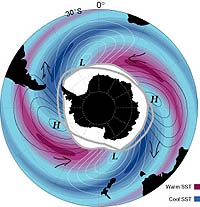
Princeton - Jan 15, 2004 A study has shown that marine life around the world is surprisingly dependent on a single ocean circulation pattern in the Southern Hemisphere where nutrient-rich water rises from the deep and spreads across the seas. The results suggest that ocean life may be more sensitive to climate change than previously believed because most global warming predictions indicate that major ocean circulation patterns will change. While oceanographers have identified many ocean circulation patterns, the study found that three-quarters of all biological activity in the oceans relies on this single pattern. "When we shut off this one pathway in our models, biological productivity in the oceans drops to one-quarter of what it is today," said Jorge Sarmiento, a Princeton oceanographer who led the study published in the Jan. 1, 2004, issue of Nature. Marine organisms account for half all biological productivity on Earth. The discovery helps oceanographers settle a longstanding question about what keeps the world's oceans fertile. Most biological activity in the ocean is concentrated near the surface where an abundance of microorganisms perform photosynthesis and support marine food chains. These organisms and their byproducts slowly sink from the surface, decomposing along the way and carrying nutrients to the deep ocean. Until now, it has not been clear how the surface becomes replenished with the nutrients that seemed lost to the deep ocean. Previous research has shown that ocean water does not mix well across layers of equal density, which are mostly oriented horizontally in the ocean. Once the organic matter sinks to the abyss, it takes a long time for nutrients to cross the layers and return to the surface. Without a mechanism to bring deep water back to the surface, the oceans would lose about one-fiftieth of their nutrients to this sinking process each year, Sarmiento said. Sarmiento and colleagues identified what amounts to an enormous conveyor belt that carries nutrient-rich seawater southward in the deep ocean, brings it to the surface in the Antarctic Ocean where the density layer barrier is weak and ships it north. The water sinks again in the Northern Hemisphere and starts over. The researchers discovered a chemical signature (the presence of high nitrate and low silicate levels) that is unique to this nutrient carrier, which is called the Subantarctic Mode Water, and used it to trace the influence of this water in surface waters around the world. "It is really quite amazing," said Sarmiento. "I had no idea of the extent of its influence." The SAMW is responsible for feeding nearly all the world's oceans, except for the North Pacific, which is resupplied with nutrients through another circulation pattern, the researchers found. The finding already has attracted interest among oceanographers. "They have clearly identified the pathway that counteracts the so-called biological pump, which acts to strip the surface layer of its nutrients," said Arnold Gordon of Columbia University. "One now wonders how global change will alter the efficiency of this pathway." Sarmiento said the research group "is now hard at work investigating the details of this nutrient circulation pattern with an eye to examining how it might respond to global warming in model simulations." Community Email This Article Comment On This Article Related Links Princeton University SpaceDaily Search SpaceDaily Subscribe To SpaceDaily Express Dirt, rocks and all the stuff we stand on firmly
 Environmental Damage Threatens Human Health
 Bangkok (AFP) Dec 9, 2005
Environmental damage threatens human health and may have contributed to the spread of new diseases like bird flu and SARS, the World Health Organization said in a report Friday. |
|
|

| The content herein, unless otherwise known to be public domain, are Copyright 1995-2006 - SpaceDaily.AFP and UPI Wire Stories are copyright Agence France-Presse and United Press International. ESA PortalReports are copyright European Space Agency. All NASA sourced material is public domain. Additionalcopyrights may apply in whole or part to other bona fide parties. Advertising does not imply endorsement,agreement or approval of any opinions, statements or information provided by SpaceDaily on any Web page published or hosted by SpaceDaily. Privacy Statement |