|
 |
 |
 |
 |
 |
 |
 |
 |

 |
Ocean Invaders In Deep Time
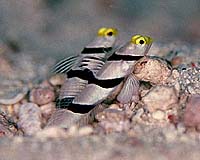
Panama (SPX) Oct 14, 2005 Much has been made of the economic impacts of recent biological invasions, but what are the implications of invasions in deep time? Luiz Rocha leads geneticists who time travel through ocean environments. The results of their travels, published online in Molecular Ecology, tell us that during warm, interglacial periods, reef-associated fish (goby genus Gnatholepis), leapt around the horn of Africa into the Atlantic, where their range expanded as the world warmed. "We found that global warming events correspond clearly with major range expansions of gobies from the Indian Ocean into the Atlantic Ocean and subsequently into the Eastern Atlantic," summarizes Rocha. A chilly Antarctic current - the Benguela upwelling system - surges up along the western coast of Africa acting as a natural barrier, and has prevented most warm water organisms from the Indian Ocean from making it in to the Atlantic for the last 2 million years. But when the world warmed about 150,000 years ago, gobies slipped around the corner of the continent. Researchers at the Smithsonian Tropical Research Institute, Scripps Institution of Oceanography, Hofstra University and the University of Hawaii, sequenced goby DNA (774 pb of the mtDNA of cytochrome b, to be exact) from the western, central and eastern Atlantic Ocean. They also sequenced DNA from gobies in the same genus from South Africa, from the Cocos Keeling Islands in the eastern Indian Ocean, and from the Cook Islands in the South Pacific. They calculate the approximate amount of time that isolated groups of fish have been separate based on the differences in the DNA between groups. What evidence do they have that makes them think that Atlantic gobies are invaders? "The Atlantic goldspot goby certainly is a prime candidate-it's the only species of the genus in the Atlantic and there are eight species and subspecies in the Indo-Pacific. It's really similar to a sister taxon in the Indian Ocean," Rocha continues. "We nailed down the timeline of the invasion by sequencing--the last time there was tropical ocean connecting these two areas was 2 million years ago. We calculate that these fish invaded the Atlantic Ocean during a warm period about 150,000 years ago and arrived in the eastern Atlantic only 30,000 years ago." What future effects of climate change might we expect in the marine realm? "Genetic analysis told us that fish from the Indian Ocean breached the Benguela barrier in the past, and this barrier seems to open intermittently. It would be reasonable to expect that other organisms limited by cold water barriers will continue to expand their ranges during warm periods."
Ref. Rocha, L.A., Robertson, D.R., Rocha, C., Van Tassell, J.L., Craig, M.T., Bowen, B.W. 2005. Recent invasion of the tropical Atlantic by an Indo-Pacific coral reef fish. Molecular Ecology online. Community Email This Article Comment On This Article Related Links Smithsonian Tropical Research Institute SpaceDaily Search SpaceDaily Subscribe To SpaceDaily Express Water News - Science, Technology and Politics
 China To Improve Water Supply
 Beijing (XNA) Dec 18, 2005
Chinese Vice Premier Hui Liangyu said Saturday China will speed up construction of water supply projects, while giving priority to water conservancy for sustainable use of water resources in the coming year. |
|
|

| The content herein, unless otherwise known to be public domain, are Copyright 1995-2006 - SpaceDaily.AFP and UPI Wire Stories are copyright Agence France-Presse and United Press International. ESA PortalReports are copyright European Space Agency. All NASA sourced material is public domain. Additionalcopyrights may apply in whole or part to other bona fide parties. Advertising does not imply endorsement,agreement or approval of any opinions, statements or information provided by SpaceDaily on any Web page published or hosted by SpaceDaily. Privacy Statement |