|
 |
 |
 |
 |
 |
 |
 |
 |

 |
Ocean Instrument Program Led By Scripps Set To Achieve World Coverage
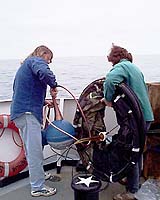
San Diego CA (SPX) Sep 19, 2005 An ambitious idea spawned more than 20 years ago to develop a new way to watch the world change has come to fruition. The Global Drifter Program (GDP), largely led by Scripps Institution of Oceanography at the University of California, San Diego, and Scripps Distinguished Professor Peter Niiler, will meet its lofty goal of blanketing the globe on Sept. 18 when the program's 1,250th instrument is dropped in the ocean off Halifax, Nova Scotia, Canada. GDP buoys, also called drifters, are designed to travel the oceans taking measurements of sea surface temperatures, ocean currents, air pressure and other parameters. By linking and disseminating the information relayed from each of these instruments in a global network, scientists and others have been able to produce new details about the world's ocean processes, key information for weather and climate forecasting and important calibrations of satellite readings. "When the GDP drifter data is combined with satellite measurements we can now obtain a complete, accurate map of the sea surface temperature of the world twice per week," said Niiler, a scientist in the Physical Oceanography Research Division at Scripps. "These 'weather maps' of the ocean surface will tell us how Earth is warming up and where it is warming more than in other places. These combined data also give us an accurate picture of the changing currents and patterns of ocean circulation." The GDP is a component of the National Oceanic and Atmospheric Administration's (NOAA) Global Ocean Observing System and Global Climate Observing System. According to Niiler, more than 250 research papers have been published with new findings derived through GDP circulation measurements. Many more have used its sea temperature measurements. Topics have ranged from El Ni�os and La Ni�as to global climate change. Niiler believes the impact of GDP information will continue to grow because of the distinct characteristics displayed in current systems off coasts around the world. Analyzing the strongest north-south current system in the world, the Agulhas Current off the eastern coast of South Africa, tells a much different story than studying the California Current, the north-south circulation of the north Pacific Ocean that travels just off California's waters. "The GDP observations are of great interest to people all over the world," said Niiler. "If you want to know what's happening in your backyard, or you want to know what's happening on a global basis, these data will assist you." When Niiler called a meeting of scientists in Boulder, Colo., in 1982, surface temperature readings and circulation patterns were a mystery in large regions of the world, especially in the Southern Ocean. "A large part of the world simply could not be sampled," said Niiler, "because most of the world's ships don't go there. We needed a new way." Niiler and his colleagues resolved that such gaps could only be filled with a completely new system of observing the entire Earth's oceans. They also decided that this mission could only be accomplished with the development of new ocean instruments. With long-term support from Scripps, Niiler and his colleagues began to work with engineers in designing and developing low-cost, rugged drifters that measure currents with high accuracy and relay their sensor information through existing satellite communications systems. Scripps and Niiler eventually led the design, manufacture, deployment and research analysis of the program. Yet Scripps scientists could not do it all alone, Niiler stresses, and national and international partners played a significant role in the program's development through organizations that include NOAA's Atlantic Oceanographic and Meteorological Laboratory, various meteorological groups, oceanographers from 20 countries and nearly all United States government research funding agencies. In the future, NOAA will provide about 80 percent of the drifters to maintain the array. Although the GDP has met its goal of populating the global ocean with 1,250 drifters, the array of instruments has become so valuable to science and other applications that the network will continue to grow. Challenges associated with drifter deployments in areas rarely visited by ships will be addressed by increasing future deployments by air. Drifters are now deployed by the United States Air Force's "Hurricane Hunter Squadron" in front of hurricanes to obtain data on hurricane strength and size. New ways of using the drifters as platforms for environmental sensors also are being explored, including measurements for rain, biochemical concentrations and surface conductivity. Community Email This Article Comment On This Article Related Links Scripps Institution of Oceanography SpaceDaily Search SpaceDaily Subscribe To SpaceDaily Express Water News - Science, Technology and Politics
 China To Improve Water Supply
 Beijing (XNA) Dec 18, 2005
Chinese Vice Premier Hui Liangyu said Saturday China will speed up construction of water supply projects, while giving priority to water conservancy for sustainable use of water resources in the coming year. |
|
|

| The content herein, unless otherwise known to be public domain, are Copyright 1995-2006 - SpaceDaily.AFP and UPI Wire Stories are copyright Agence France-Presse and United Press International. ESA PortalReports are copyright European Space Agency. All NASA sourced material is public domain. Additionalcopyrights may apply in whole or part to other bona fide parties. Advertising does not imply endorsement,agreement or approval of any opinions, statements or information provided by SpaceDaily on any Web page published or hosted by SpaceDaily. Privacy Statement |