|
 |
 |
 |
 |
 |
 |
 |
 |

 |
Ocean Extreme Shows Its Spine
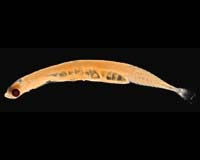
Moffett Field CA (SPX) Jul 26, 2004 Scientists in San Diego have described the earth's smallest, lightest animal with a backbone. H.J. Walker of Scripps Institution of Oceanography at the University of California, San Diego, and William Watson of the Southwest Fisheries Science Center, National Marine Fisheries Service, in La Jolla have identified the miniscule "stout infantfish," a new species no longer than the width of a pencil. Found exclusively in the vicinity of Australia's Great Barrier Reef and the Coral Sea, only six specimens are known to exist. The largest specimen-and only female-measures approximately a third of an inch (8.4 millimeters) while the males measure just over a quarter of an inch (7 millimeters). Roughly 500,000 of these fish weighed together would barely tip the scales at one pound. A full scientific description of the animal was published in the latest issue of Records of the Australian Museum. The first stout infantfish was captured in 1979 by the Australian Museum's Jeff Leis during fieldwork in the Lizard Island / Carter Reef area of the Great Barrier Reef. After it was left unstudied for years, Watson and Walker recently analyzed the animal in detail for the first time. They spent roughly six months studying the creature but instantly recognized it as something special. "It was a really good day when I first looked under the microscope and recognized something that I knew was a new species. I said to myself, 'Wow, this is really great,'" said Walker, a senior museum scientist in the Scripps Marine Vertebrates Collection. "But at the time I didn't realize that I was looking at the world's smallest vertebrate." The stout infantfish supplants the dwarf goby as the new record holder of the world's smallest vertebrate (animal with a backbone). The scientists developed the animal's name (scientific name Schindleria brevipinguis) to characterize its thick, or "stout," structure as compared with other infantfishes. "Infant" describes the uncommon early-stage features of the animal. It is transparent without pigmentation, except for its eyes, and lacks teeth, scales and certain characteristics typical of other fishes. Scientists note that the stout infantfish's unusual appearance corresponds with its extremely short lifespan, which is believed to be approximately two months. Many features characteristic of a larval stage of development appear even though it is fully mature. "It's interesting that these animals experience several generations each year," said Watson, a fishery biologist. "This suggests that they could evolve quite quickly as well. They live in a specialized habitat that could be threatened by global warming or human development, but they may have the ability to evolve as fast as their environment changes." Philip Hastings, the curator of the Scripps Marine Vertebrates Collection, says the identification of the stout infantfish is another demonstration that scientists do not yet possess a complete inventory of marine animals, even for relatively well-studied groups like fishes, and in fact many important species remain undiscovered. "Anytime a scientist identifies an 'extreme' in the world it's important," said Hastings. "Think about the whole envelope of life. Most of us systematists describe things that fill in the dots in the middle of the envelope. This new discovery is pushing the edge, increasing the size of the envelope." "It's important because it demonstrates that we're still expanding our knowledge of the limits of the diversity that's present on this planet and there are still significant new discoveries to be made. We need to continue doing what we can to explore and describe the diversity before it's gone, in addition to focusing our efforts on protecting biodiversity." Other recent examples of discoveries of new fish species by Scripps scientists include the description of the "saddled prickleback," a species that lives on the sea bottom, discovered off San Diego's coastline, and the "orangeflag blenny," a species found on reefs off Belize. New discoveries continue to unfold near and far. The recent findings also underscore the importance of scientific resources such as Scripps's invaluable Marine Vertebrates Collection. This collection of more than two million fish specimens is used by researchers at Scripps and around the world to uncover new information about the animal world. "Collections such as these provide an enormous library of materials that allow us to make comparisons for new discoveries," said Hastings. "Unless you know what's already known, you don't know what's new." Community Email This Article Comment On This Article Related Links SpaceDaily Search SpaceDaily Subscribe To SpaceDaily Express Water News - Science, Technology and Politics
 China To Improve Water Supply
 Beijing (XNA) Dec 18, 2005
Chinese Vice Premier Hui Liangyu said Saturday China will speed up construction of water supply projects, while giving priority to water conservancy for sustainable use of water resources in the coming year. |
|
|

| The content herein, unless otherwise known to be public domain, are Copyright 1995-2006 - SpaceDaily.AFP and UPI Wire Stories are copyright Agence France-Presse and United Press International. ESA PortalReports are copyright European Space Agency. All NASA sourced material is public domain. Additionalcopyrights may apply in whole or part to other bona fide parties. Advertising does not imply endorsement,agreement or approval of any opinions, statements or information provided by SpaceDaily on any Web page published or hosted by SpaceDaily. Privacy Statement |