|
 |
 |
 |
 |
 |
 |
 |
 |

 |
Observing Einstein's Gravitational Waves
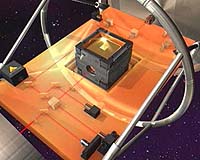
Hanover, Germany (SPX) Apr 11, 2005 A hundred years ago, Albert Einstein published his theory of relativity. On this occasion, Euronews' Space magazine plunges into the subject of gravitational waves and features the joint ESA-NASA "LISA" mission which hopes to detect them in space. The existence of gravitational waves stems from Einstein's postulates. When very massive bodies are disturbed, they radiate waves or ripples that travel through space. Objects they encounter vibrate without moving, but as a consequence of the deformation of the space-time texture in which they are at rest. The Laser Interferometer Space Antenna (LISA) mission, whose launch is envisaged for 2013, will use laser interferometers - very sensitive tools to measure tiny variations in the distance between objects � and proof masses on board three spacecraft flying in formation. The system is designed to detect low-frequency gravitational waves which originate from, for instance, black holes swallowing massive neutron stars or binary star systems revolving around each other. They were also produced at the very origins of time, when the Big Bang occurred. "As far as we know, the Universe began 13.7 billion years ago," explains Karsten Danzmann, Principal Investigator for the LISA mission at the Max-Planck-Institut fur Gravitationsphysik in Hanover in Germany. "We have the dream of listening to that Big Bang itself by detecting and studying gravitational waves. It will give us a chance of listening to the dark, invisible side of the Universe." Gravitational waves are so weak they are extremely difficult to hear. Because of our planet's own gravity, laser interferometers on Earth can only detect high frequencies, stemming from sources which are relatively close. "If you want to listen to the high pitch notes of a concert you can do so with small ears, but if you want to listen to the real low pitches, you need big ears, and the only place where you can have big ears is in space," says Danzmann. The LISA mission is one of the most ambitious ever undertaken: positioning and flying three spacecraft in a triangular formation, 5 million kilometres apart. The constellation will orbit the Sun, following the Earth at a distance of 50 million kilometres so as not to be perturbed by its gravity. Infrared lasers will be beamed between the spacecraft, arriving on small 2-kilogram proof masses, 4-centimetre cubes made of gold and platinum. At the University of Trent in Italy, Euronews was able to see the first of these proof masses destined for the LISA Pathfinder precursor mission. Due to be launched in 2008, its single satellite will test the general concepts and technologies of the LISA mission. "We will be flying totally new technologies in space," says Professor Stefano Vitale, the Principal Investigator for the LISA Pathfinder mission. "The structure of the satellites will protect the proof masses. They will float much like astronauts hover in the void of space. But their precise position will be constantly monitored to detect when they are influenced by a passing gravity wave." Precise is a euphemism when one details the accuracy of such measurements: LISA will need to detect infinitely minute movements of the proof masses, of the order of a tenth of an atom, that is a billionth of a millimetre! It will also identify the polarisation of waves, and thus the direction they come from. The detection of these gravitational waves will complete the missing links in Einstein's theory of relativity and throw wide-open a new avenue of exploration in fundamental physics and astronomy. "Einstein had foreseen the eventual detection of gravitational waves," concludes Stefano Vitale. "But a hundred years ago, no suitable instruments were available and Einstein's work was entirely theoretical. Now we have the technologies, we are picking up the challenge, and he would no doubt be greatly pleased to see that we are pursuing his work." Community Email This Article Comment On This Article Related Links LISA overview LISA factsheet SpaceDaily Search SpaceDaily Subscribe To SpaceDaily Express Understanding Time and Space
 Unified Physics Theory Explains Animals Running Flying And Swimming
 Durham NC (SPX) Jan 05, 2006
A single unifying physics theory can essentially describe how animals of every ilk, from flying insects to fish, get around, researchers at Duke University's Pratt School of Engineering and Pennsylvania State University have found. The team reports that all animals bear the same stamp of physics in their design. |
|
|

| The content herein, unless otherwise known to be public domain, are Copyright 1995-2006 - SpaceDaily.AFP and UPI Wire Stories are copyright Agence France-Presse and United Press International. ESA PortalReports are copyright European Space Agency. All NASA sourced material is public domain. Additionalcopyrights may apply in whole or part to other bona fide parties. Advertising does not imply endorsement,agreement or approval of any opinions, statements or information provided by SpaceDaily on any Web page published or hosted by SpaceDaily. Privacy Statement |