|
 |
 |
 |
 |
 |
 |
 |
 |

 |
OICETS Undergoing Flight Configuration
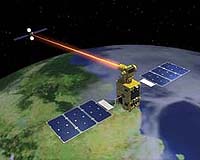
Tsukuba, Japan (SPX) Apr 18, 2005 The OICETS (Optical Inter-orbit Communications Engineering Test) satellite, scheduled to be launched this coming summer, is being modified to match a change of inclination (from 35 to 98 degrees), due to a change of its launch vehicle. Final satellite verification began in February, with all operations at the manufacturer's plant complete. The satellite is now in its flight configuration stage. Since the start of April, OICETS has been tested using facilities at the Tsukuba Space Center and the DRTS (the data relay satellite "Kodama") to assess its overall performance. On April 8, an acoustic test was carried out. OICETS enables communications between satellites via optical links. OICETS will enable optical inter-orbit communications tests between satellites that are tens of thousands of kilometers apart. An optical inter-orbit communications system will bring various advantages: more stable communications with less interference; lighter, more compact communications equipment; and higher data transmission rates. These tests are expected to lead to new technologies that will improve global data reception from Earth Observation satellites and continuous communication links with manned space stations. OICETS is to be launched into a low Earth orbit in the fiscal year 2005, for the purpose of conducting demonstrations with ARTEMIS, the latest geostationary satellite belonging to the European Space Agency.
Communications Engineering Tests The distance between ARTEMIS, a stationary satellite, and OICETS, positioned in a low Earth orbit, will be around 45,000km at its maximum point. As a result, optical inter-orbit communications tests require elements like high-gain optical antennas, a high-power semiconductor laser, and highly sensitive signal detectors. Using these devices, JAXA will be able to test beam acquisition operations: to take in an incoming laser beam; beam tracking, to detect and control the angle of an incoming laser; and beam pointing, to accurately transmit a laser beam in the right direction, taking into consideration the relative motion between the two satellites. Important issues to be tackled, still, include the need for technologies to establish a stabilized, high-capacity attitude-control system, and to build ground stations to evaluate the performance of the optical inter-orbit communications equipment. Community Email This Article Comment On This Article Related Links SpaceDaily Search SpaceDaily Subscribe To SpaceDaily Express Space Technology News - Applications and Research
 TeleRay Mobile Sat TV Antenna For Japan Auto Market
 Las Vegas CA (SPX) Jan 5, 2006
RaySat has introduced TeleRay, the world's smallest satellite TV vehicle antenna, into the domestic Japanese automotive market. |
|
|

| The content herein, unless otherwise known to be public domain, are Copyright 1995-2006 - SpaceDaily.AFP and UPI Wire Stories are copyright Agence France-Presse and United Press International. ESA PortalReports are copyright European Space Agency. All NASA sourced material is public domain. Additionalcopyrights may apply in whole or part to other bona fide parties. Advertising does not imply endorsement,agreement or approval of any opinions, statements or information provided by SpaceDaily on any Web page published or hosted by SpaceDaily. Privacy Statement |