|
 |
 |
 |
 |
 |
 |
 |
 |

 |
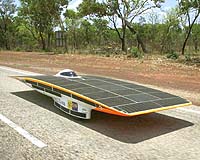
Nuna Holds 28 Minute Lead In Australian SolarCar Classic
Alice Springs - Oct 21, 2003 Leading solar cars reach Alice Springs The World Solar Challenge has developed into a three-way struggle between Australia, the Netherlands and the United States with the leading cars all reaching Alice Springs by 5pm this evening. The flying Dutch Nuna II car has opened a 28-minute lead over Australia's Aurora, as the cars fast approach the South Australian border. The struggle for second place has intensified, with Tesseract, entered by the Massachusetts Institute of Technology, just one minute further back near the half-way stage of the 3010 kilometre event. Canada's Queen's University Solar Vehicle Team is fourth, with Gemini, and was tonight camped just north of Ti Tree, more than 200 kilometres adrift of the leaders. World Solar Challenge event manager Chris Selwood said the cars made good time today in perfect weather conditions. "The Nuon Solar Team must be very pleased with the performance of Nuna II today, although it certainly can't afford to relax with Aurora and Tesseract so close behind," he said. Weather permitting, the Dutch favourites are expected to break their previous record of 32 hours and 39 minutes set in 2001 for the Darwin to Adelaide challenge. All 22 teams are still in the competition, although the teams are now stretched out throughout the Northern Territory.
earlier report Nuna 2 is two to three minutes ahead of their closest competitors, the Aurora team from Australia and the MIT team from the United States. Nuna 2 has so far driven 1493 km out of the total 3010 km in this challenging race across Australia. The closest competitor finished today 4 km behind. The weather is fine and the Dutch team is presently preparing to camp out at Alice Springs, ready for an early start on Day 3 ( at 0.30 hours tonight Central European time). On the first race day of the World Solar Challenge race Nuna II, the solar car equipped with the most recent space technology, has taken the lead after only three hours. The Dutch team, nicknamed 'the Flying Dutchmen' by the Australian press, hopes to finish first this Wednesday. At 8 a.m. local time, driver Mark Olsthoorn started in Darwin with Nuna II in 10th start position amongst 28 other cars. Shortly after 11 a.m. he managed to take the lead from the American MIT team. From that moment on Nuna II stayed in pole-position on the Stuart Highway, heading for Adelaide. At the end of the race day at 5 p.m. Nuna II had travelled at total distance of 775 kilometres - 50 kilometres more than two years ago when the Dutch team won the first race day and went on to win overall. At 11.35 a.m. Nuna II arrived first at the checkpoint in Katherine, located 320 km from Darwin. The Dutch were followed after two minutes by the MIT-team and then by the Australian Aurora team 8 minutes later. The Aurora team had started from pole-position, but had to give up the lead after a flat tire. In the 310 km after the first check point driver Sten Swanenberg increased his lead. At the second checkpoint Swanenberg said about his ride: "Nuna II drives perfectly and at a speed of 120 km/h it starts to run really well." The Aurora team had just arrived at the second checkpoint as Martijn Hinderdeal took his place in the Nuna cockpit and left for the final stage of the day. The sun had been shining nearly all day, only becoming very cloudy in the last stage of the day. By the end of the first day the Dutch team had a half hour lead on the Aurora and MIT teams. Monday morning 20 October at 8 a.m. local time (00.30 CEST) the team will continue from the location where they finished Sunday. Every day the teams have to stop by 5 p.m. local time and make camp at the location where they finished. The Nuon Solar Team is a group of students from the TU (Technical University) Delft and the Erasmus University Rotterdam. This team built the Nuna II � a car that drives on solar energy - in Delft. Nuna II is the successor of solar car Nuna that won the World Solar Challenge 2001. This 3010 km long race is considered the world championship for solar cars. Nuna II makes use of the newest space technology in a sustainable way and takes into account the changing weather conditions through an ingenious software program developed in cooperation with ESA. This year the race started on 19 October. The Nuon Solar Team is made possible by sponsors: Nuon (main sponsor), ESA and the TU Delft. Community Email This Article Comment On This Article Related Links SpaceDaily Search SpaceDaily Subscribe To SpaceDaily Express All About Solar Energy at SolarDaily.com
 Tiny Crystals Promise Big Benefits For Solar Technologies
 Los Alamos NM (SPX) Jan 9, 2006
Los Alamos National Laboratory scientists have discovered that a phenomenon called carrier multiplication, in which semiconductor nanocrystals respond to photons by producing multiple electrons, is applicable to a broader array of materials that previously thought. |
|
|

| The content herein, unless otherwise known to be public domain, are Copyright 1995-2006 - SpaceDaily.AFP and UPI Wire Stories are copyright Agence France-Presse and United Press International. ESA PortalReports are copyright European Space Agency. All NASA sourced material is public domain. Additionalcopyrights may apply in whole or part to other bona fide parties. Advertising does not imply endorsement,agreement or approval of any opinions, statements or information provided by SpaceDaily on any Web page published or hosted by SpaceDaily. Privacy Statement |