|
 |
 |
 |
 |
 |
 |
 |
 |

 |
Now Scientists Think You'd Be 'Roasted' In A Black Hole
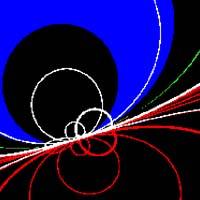
Boulder CO (SPX) Apr 15, 2005 Contrary to established scientific thinking, you'd be roasted and not "spaghettified" if you stumbled into a supermassive black hole. New research being presented at the Institute of Physics conference 'Physics 2005' in Warwick will take a new look at the diet of the universe's most intriguing object, black holes. Black holes stand at the very edge of scientific theory. Most scientists believe they exist, although many of their theories break down under the extreme conditions within. But Professor Andrew Hamilton of the University of Colorado says he knows what you would find inside, and challenges the traditional idea that gravity would cause you death by "spaghettification". Most people have heard of the event horizon of a black hole, as the point of no return. But astronomically realistic black holes are more complex and should have two horizons, an outer and an inner. In the bizarre physics of black holes, time and space are exchanged when you cross an event horizon, but at a second horizon they would switch back again. Travelling into a black hole, you would therefore pass through a strange region where space is falling inward faster than light, before finally entering a zone of normal space at the core. It's this core of normal space which Professor Hamilton has been working on. A so-called singularity sits at the centre of the core, swallowing up matter. But according to Professor Hamilton, the strange laws of general relativity temper its appetite. If the singularity ate too quickly, it would become gravitationally repulsive, so instead, matter piles up in a hot, dense plasma filling the core of the black hole and siphoning gradually into the singularity. Depending on the size of the black hole, this plasma could be the cause of a space traveller's demise. Most books will tell you that under the extreme gravitational conditions of a black hole, your feet would experience gravity more strongly than your head, and your body would be stretched out like spaghetti. For a small black hole with the mass of several suns, this should still be true. But for a supermassive black hole weighing millions or billions of suns, explains Professor Hamilton, the tidal forces which cause spaghettification are relatively weak. You would instead be roasted by the heat of the plasma. Professor Andrew Hamilton is Professor of Astrophysics at the Department of Astrophysical and Planetary Sciences, University of Colorado. CommunityEmail This Article Comment On This Article Related Links Institute of Physics Andrew Hamilton's website University of Colorado SpaceDaily Search SpaceDaily Subscribe To SpaceDaily Express Black Hole Science and News
 MIT: SpInning Black Hole Leaves Dent In Space-Time
 Boston MA (SPX) Jan 12, 2006
MIT scientists and colleagues have found a black hole that has chiseled a remarkably stable indentation in the fabric of space and time, like a dimple in one's favorite spot on the sofa. |
|
|

| The content herein, unless otherwise known to be public domain, are Copyright 1995-2006 - SpaceDaily.AFP and UPI Wire Stories are copyright Agence France-Presse and United Press International. ESA PortalReports are copyright European Space Agency. All NASA sourced material is public domain. Additionalcopyrights may apply in whole or part to other bona fide parties. Advertising does not imply endorsement,agreement or approval of any opinions, statements or information provided by SpaceDaily on any Web page published or hosted by SpaceDaily. Privacy Statement |