|
 |
 |
 |
 |
 |
 |
 |
 |

 |
Novarupta And The Next Nuclear Winter
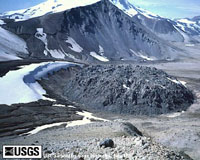
New York NY (SPX) Oct 04, 2006 In June 1912, Novarupta - one of a chain of volcanoes on the Alaska Peninsula - erupted in what turned out to be the largest blast of the twentieth century. It was so powerful that it drained magma from under another volcano, Mount Katmai, six miles east, causing the summit of Katmai to collapse to form a caldera half a mile deep. Novarupta also expelled three cubic miles of magma and ash into the air, which fell to cover an area of 3,000 square miles more than a foot deep. Despite the fact that the eruption was comparable to that of the far more famous eruption of Krakatau in Indonesia in 1883 and so near the continental United States, it was hardly known at the time because the area was so remote from English-speaking people. Almost a hundred years later, researchers are paying attention. Novarupta is near the Arctic Circle and its impact on climate appears to be quite different from that of "ordinary" tropical volcanoes, according to recent research by climatologists using a NASA computer model. When a volcano anywhere erupts, it does more than spew clouds of ash, which can shadow a region from sunlight and cool it for a few days. It also blows sulfur dioxide-a gas irritating to the lungs and smelling like rotten eggs. If the eruption is strongly vertical, it shoots that sulfur dioxide high into the stratosphere more than 10 miles above Earth. Up in the stratosphere, sulfur dioxide reacts with water vapor to form sulfate aerosols. Because these aerosols float above the altitude of rain, they don't get washed out. They linger, reflecting sunlight and cooling Earth's surface. This can create a kind of nuclear winter (a.k.a. "volcanic winter") for a year or more after an eruption. In April 1815, for instance, the Tambora volcano in Indonesia erupted. The following year, 1816, was called "the year without a summer," with snow falling across the United States in July. Even the smaller June 1991 eruption of Pinatubo in the Philippines cooled the average temperature of the northern hemisphere summer of 1992 to well below average. But both those volcanoes as well as Krakatau were in the tropics. Novarupta is just south of the Arctic Circle. Using a NASA computer model at the the Goddard Institute for Space Studies (GISS), Prof. Alan Robock of Rutgers University and colleagues found that Novarupta's effects on the world's climate would have been different. (Their research was funded by the National Science Foundation.) Robock explains: "The stratosphere's average circulation is from the equator to the poles, so aerosols from tropical volcanoes tend to spread across all latitudes both north and south of the Equator," quickly circulating to all parts of the globe. But the NASA GISS climate model showed that aerosols from an arctic eruption such as Novarupta tend to stay north of 30N-that is, no further south than the continental United States or Europe. Indeed, they would mix with the rest of Earth's atmosphere only very slowly. This bottling up of Novarupta's aerosols in the north would make itself felt, strangely enough, in India. According to the computer model, the Novarupta blast would have weakened India's summer monsoon, producing "an abnormally warm and dry summer over northern India," says Robock. Why India? Cooling of the northern hemisphere by Novarupta would set in motion a chain of events involving land and sea surface temperatures, the flow of air over the Himalayan mountains and, finally, clouds and rain over India. It's devilishly complex, which is why supercomputers are needed to do the calculations. To check the results, Robock and colleagues are examining weather and river flow data from Asia, India, and Africa in 1913, the year after Novarupta. They are also investigating the consequences of other high-latitude eruptions in the last few centuries. Community Email This Article Comment On This Article Related Links Goddard Institute for Space Studies Bringing Order To A World Of Disasters When the Earth Quakes A world of storm and tempest
 Typhoon Death Toll Nears 250 In Vietnam Philippines
 Manila (AFP) Oct 03, 2006
The death toll from Typhoon Xangsane in the Philippines and Vietnam neared 250 on Tuesday with dozens more still missing, as officials warned flash floods and landslides could still claim more lives. At least 207 people have been killed in the Philippines, which was battered by the storm last week before it barreled into the central coast of Vietnam, where at least 42 people have lost their lives since Sunday. |
|
|

| The content herein, unless otherwise known to be public domain, are Copyright 1995-2006 - SpaceDaily.AFP and UPI Wire Stories are copyright Agence France-Presse and United Press International. ESA PortalReports are copyright European Space Agency. All NASA sourced material is public domain. Additionalcopyrights may apply in whole or part to other bona fide parties. Advertising does not imply endorsement,agreement or approval of any opinions, statements or information provided by SpaceDaily on any Web page published or hosted by SpaceDaily. Privacy Statement |