|
 |
 |
 |
 |
 |
 |
 |
 |

 |
Nothing will be left to chance in Discovery's launch: NASA chief
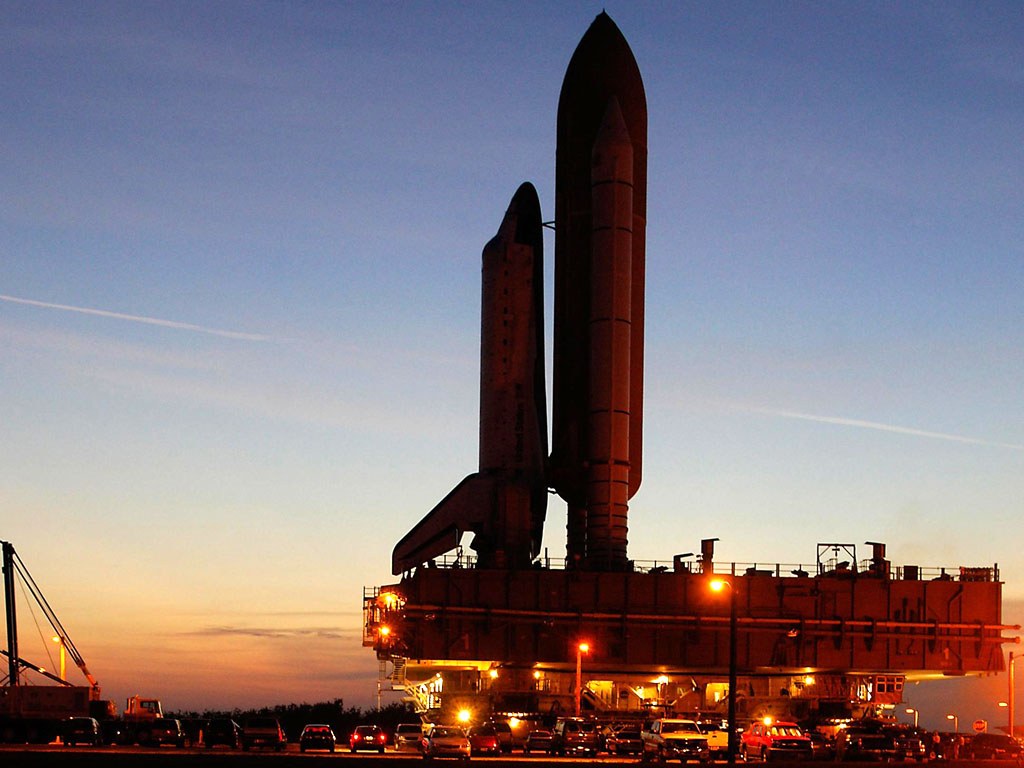
Washington (SPX) Apr 20, 2005 NBC News reported Tuesday evening that NASA is expected to announced later today a one week delay to May 22 for the earliest possible launch date for Discovery. With a new administrator on board, and a host of safety issues relating to the accident investigation's final report still to be finalized, NASA faces a series of tough decisions in returning the Space Shuttle to flight. The launch window opening in mid-May closes June 5 at the latest, before reopening in July. New safety regulations require the Shuttle to be clearly visible to ground cameras during lift off to track any debris that may fall from the Shuttle's external tank. With an estimated $15 billion spent on NASA's Space Shuttle operations and upgrades to the shuttle fleet since Columbia was destroyed during reentry February 1, 2003, the Shuttle program will need to have a smooth return to flight with minimal delays over the remainder of 2005. NASA's newly appointed administrator Michael Griffin is on record as deeply questioning the logic behind the Shuttle program that soaks up over a third of the agency's annual budget for minimal returns. But with Congressional support split on how exactly to take the Federal space program forward, NASA may find itself adrift with only platitudes and rhetoric providing direction.
earlier related report "We wont delay things gratuitously ... But we wont launch precipitously either," Griffin said Monday at his first press briefing since he was appointed to head the National Aeronautics and Space Administration on Thursday. "I want to make sure that we leave absolutely no stone unturned in making certain that we are as safe as we know how to be in flight," he said. The Discovery is set to break a shuttle flight fast of more than two years after the February 1, 2003 disintegration on reentry of the shuttle Columbia that killed all seven astronauts on board. The May 15 launch date, first of a 20-day launch window for the Discovery's mission, still remains in doubt since NASA still has to conduct a technical review of the shuttle and meet the 15 recommendations made by an investigative panel set up after the Columbia tragedy. The crucial review will take place on Tuesday at the Kennedy Space Center in Cape Canaveral, Florida, where Griffin said he would meet with the Discovery team. He said he would make sure he had all the technical assurances needed before giving the go-ahead for the launch. The oversight group monitoring the "return-to-flight" operations at the space center, cannot make a decision before the technical review, which has been delayed several times, Griffin said. The NASA chief said he would take the independent panel of experts' advice very seriously on whether the space agency has met the 15 recommendations they made before shuttle missions can resume, essentially to finish building the orbiting ISS. Nonetheless, Griffin stressed that the final decision was up to NASA, regardless of what the experts conclude. He also said that once the shuttle flights are back on track "we will begin to examine the option to extend the service life for the Hubble Space Telescope" to 2010, in a reversal of his predecessor Sean O'Keefe's decision to let the telescope die. Griffin said he intended to speed up the Crew Exploration Vehicleprogram, which is slated to replace the shuttle, to shorten the time between its expected birth in 2014 and the end of the shuttle program in 2010. "It's a major priority today to reduce the gap between the Shuttle and the CEV," he said, adding that he agreed with members of the government and Congress who consider the four-year gap excessive.
earlier related report "I could not be happier at the conclusion of the test," Deputy Space Shuttle Program Manager Wayne Hale told reporters after Thursday's test at Kennedy Space Center in Cape Canaveral, Florida. The fueling test was carried out in real time on the launch pad to check for flaws in the main fuel tank, which was modified after the 2003 tragedy of the Columbia shuttle. It tore apart on reentry into the Earth's atmosphere because of a piece of insulation that had broken off the main fuel tank on takeoff. New NASA Director Michael Griffin told employees that he was determined to resume the space shuttle program: "All other commitments will flow around what I have to do in order to support the return-to-flight decision." Discovery is scheduled to take off on May 15 on a mission to the orbiting International Space Station. Begun at 8:14 am (1214 GMT), the fueling process involving super-cooled hydrogen and oxygen also served to test the shuttle, its booster rockets and the lauch pad itself under extremely cold temperatures. "We had an outstanding day today. The new external tank performed in an outstanding manner, the shuttle performed in an outstanding manner and the launch pad performed almost without flaws," Hale said. The main tank has been provided with new insulation and four heaters to prevent ice formation, which is a constant concern whenever a shuttle blasts off. The test, which ended at 2:30pm (1830 GMT) when the Discovery's main fuel tank was drained of its propellant, cost around 500,000 dollars. It has been carried out very few times during the shuttle's 24-year history, NASA said. The Columbia disintegrated on February 1, 2003. A crack in its left wing caused by a loose piece of insulation on takeoff allowed superheated air to seep inside the structure during reentry, destroying the shuttle and killing all seven astronauts inside. NASA believes it has fixed the problem by modifying the insulating material of the main fuel tank in such a way that only small pieces of it can break off on takeoff. The shuttle crew has also been provided with the means to inspect the craft in orbit to ensure it is safe for reentry. Community Email This Article Comment On This Article Related Links SpaceDaily Search SpaceDaily Subscribe To SpaceDaily Express Space Shuttle News at Space-Travel.Com
 Heads Up, Space Station, Discovery Is Ready To Blast Off
 Cape Canaveral (AFP) Jul 12, 2005
A plastic and foam cover fell off a window of Discovery, but damage to the space shuttle was rapidly fixed and will not cause any delays, NASA said Tuesday on the eve of the planned launch. |
|
|

| The content herein, unless otherwise known to be public domain, are Copyright 1995-2006 - SpaceDaily.AFP and UPI Wire Stories are copyright Agence France-Presse and United Press International. ESA PortalReports are copyright European Space Agency. All NASA sourced material is public domain. Additionalcopyrights may apply in whole or part to other bona fide parties. Advertising does not imply endorsement,agreement or approval of any opinions, statements or information provided by SpaceDaily on any Web page published or hosted by SpaceDaily. Privacy Statement |