|
 |
 |
 |
 |
 |
 |
 |
 |

 |
Not-So-Spotty Material Breakthrough
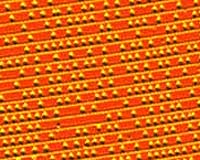
Arlington VA (SPX) Sep 02, 2004 Using pulsed lasers, researchers have coaxed the metal nickel to self-assemble into arrays of nanodots � each spot a mere seven nanometers (seven billionths of a meter) across � one-tenth the diameter of existing nanodots. Because the method works with a variety of materials and may drastically reduce imperfections, the new procedure may also bolster research into extremely hard materials and efforts to develop ultra-dense computer memory. The researchers are working with an industry partner to apply the technique to development of next-generation light-emitting diodes (LEDs) � the small, bright lights seen in traffic signals and luxury automobile brake lights. The experimental LEDs are already more efficient than existing devices, potentially lasting decades and using a fraction of the power of fluorescent bulbs. Jagdish Narayan and Ashutosh Tiwari, both of North Carolina State University and the National Science Foundation's Center for Advanced Materials and Smart Structures, invented the new materials and manufacturing processes. They announced their findings in the September, 2004, issue of Nanoscience and Nanotechnology. Narayan and Tiwari used a pulsed excimer laser to create conditions under which nickel self-assembles into 3-D, ordered arrays within aluminum oxide and titanium nitride matrices. Applying similar techniques to gallium nitride and zinc oxide, the researchers are hoping to further improve the efficiency of their LED devices. Computer applications are further away, as many additional hurdles need to be cleared before the nanodots become actual chips. However, since every nickel-metal nanodot could theoretically store a single bit of information, the researchers believe that a one-inch chip using that technology could eventually store 10 Terabits of data. According to the researchers, the chip would theoretically have several hundred times more storage than conventional microchips of the same size. Five Terabits could fit on, coincidentally, a nickel. If nanodot memory chips eventually succeed, the entire contents of the Library of Congress could fit onto a pocket full of "change." Community Email This Article Comment On This Article Related Links North Carolina State University SpaceDaily Search SpaceDaily Subscribe To SpaceDaily Express Nano Technology News From SpaceMart.com Computer Chip Architecture, Technology and Manufacture
 Water, Water Everywhere Nano
 New York (UPI) Mar 18, 2005
One of the single biggest applications of nanotechnology could be solving the global shortage of pure water, experts told UPI's Nano World. |
|
|

| The content herein, unless otherwise known to be public domain, are Copyright 1995-2006 - SpaceDaily.AFP and UPI Wire Stories are copyright Agence France-Presse and United Press International. ESA PortalReports are copyright European Space Agency. All NASA sourced material is public domain. Additionalcopyrights may apply in whole or part to other bona fide parties. Advertising does not imply endorsement,agreement or approval of any opinions, statements or information provided by SpaceDaily on any Web page published or hosted by SpaceDaily. Privacy Statement |