|
 |
 |
 |
 |
 |
 |
 |
 |

 |
Northrop Grumman Unveils Concept For Quiet Supersonic Aircraft
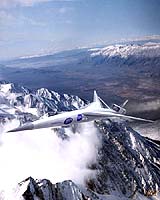
El Segundo - Oct 2, 2002 Northrop Grumman Corporation's Integrated Systems sector has unveiled a design for an efficient and capable long-range supersonic cruise aircraft that would operate with a less intense sonic boom. The design, or "preferred system concept," which includes variants for a long-range military strike aircraft and a civil business jet, is part of Northrop Grumman's work under the Defense Advanced Research Projects Agency's (DARPA) Quiet Supersonic Platform (QSP) program. QSP is focused on the validation of multiple breakthrough technologies to enable such aircraft. In addition, under a shaped sonic boom demonstration project of the QSP program, Northrop Grumman Integrated Systems has successfully completed a critical design review with DARPA, an important milestone in preparation for the first-ever flight demonstration of a sonic boom mitigated by airframe shaping. Northrop Grumman's QSP preferred concept, which culminated the company's work in Phase I of the QSP program earlier this year, incorporates dual-use technologies in a design relevant to the military strike and business jet applications. In Phase II, Northrop Grumman is focused on maturing the military design and validating the key integration technologies. The design calls for a joined-wing aircraft that is 156 feet long with a wingspan of 58 feet. It features a top-mounted, active isentropic air inlet, extensive laminar aerodynamics and wings with an adaptive leading edge. The preferred concept meets DARPA's QSP goals of 0.3-psf initial boom overpressure (approximately seven times lower than that of current commercial supersonic jets), a speed greater than Mach 2 (twice the speed of sound) and a range of 6,000 nautical miles. Northrop Grumman worked with Raytheon Aircraft Company, Wichita, Kan., its principal subcontractor during Phase I, to explore synergies with the civil sector. To evaluare the dual relevance of these technologies, Raytheon Aircraft designed the variant for the civil business jet, while Northrop Grumman designed the military long-range strike variant. The sonic boom flight demonstration, which will occur at the NASA Dryden Flight Research Center at Edwards Air Force Base, Calif., will use a Northrop Grumman F-5E aircraft with a modified fuselage. The modified aircraft is expected to produce a specially "shaped" sonic boom with significantly less intensity than the conventional sonic boom produced minutes earlier by an unmodified F-5E. Community Email This Article Comment On This Article Related Links Northrop Grumman Integrated Systems SpaceDaily Search SpaceDaily Subscribe To SpaceDaily Express Space Technology News - Applications and Research
 TeleRay Mobile Sat TV Antenna For Japan Auto Market
 Las Vegas CA (SPX) Jan 5, 2006
RaySat has introduced TeleRay, the world's smallest satellite TV vehicle antenna, into the domestic Japanese automotive market. |
|
|

| The content herein, unless otherwise known to be public domain, are Copyright 1995-2006 - SpaceDaily.AFP and UPI Wire Stories are copyright Agence France-Presse and United Press International. ESA PortalReports are copyright European Space Agency. All NASA sourced material is public domain. Additionalcopyrights may apply in whole or part to other bona fide parties. Advertising does not imply endorsement,agreement or approval of any opinions, statements or information provided by SpaceDaily on any Web page published or hosted by SpaceDaily. Privacy Statement |