|
 |
 |
 |
 |
 |
 |
 |
 |

 |
Northrop Grumman Takes Aim At Hypersonic Weapon Delivery System
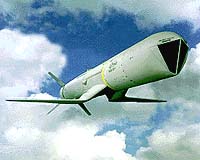
El Segundo - Nov 27, 2003 Northrop Grumman Corporation will help the Defense Advanced Research Projects Agency (DARPA) and the U.S. Air Force develop a concept for a high-speed, unmanned aircraft and related "glide weapons" that could deliver conventional, non-nuclear weapons from the U.S. to anywhere on the globe in about two hours. This hypersonic cruise weapon system would allow the U.S. to conduct effective, time-critical strike missions on a global basis without relying on overseas military bases. Northrop Grumman's six-month cost-sharing study contract will support the system definition phase (Phase I) of the joint DARPA/Air Force Application and Launch from the Continental United States (FALCON) technology demonstration program. "This project continues the investments that Northrop Grumman has made in recent years to help the U.S. government reach its goal of affordable, reusable access to space," said Doug Young, director of space access programs for Northrop Grumman's Integrated Systems sector. "The company's heritage of innovative, advanced technology strike systems and its global leadership in unmanned air vehicle systems will provide critical momentum to the nation's efforts to define, develop and deploy a military space plane." The DARPA/Air Force vision for FALCON is to develop, by 2025, a reusable hypersonic cruise vehicle that could take off from a conventional military runway and strike targets 9,000 nautical miles away in less than two hours. Flying at speeds up to eight times the speed of sound (Mach 8), the hypersonic cruise vehicle would carry a 12,000-pound payload comprising several unpowered, maneuverable, hypersonic glide vehicles called common aero vehicles; cruise missiles; small diameter bombs or other munitions. Each common aero vehicle would carry approximately 1,000 pounds in munitions. As a step toward implementing the hypersonic cruise vehicle concept, DARPA and the Air Force propose developing, by 2010, a global strike capability that would launch common aero vehicles on a low-cost, mission-responsive small launch vehicle. DARPA and the Air Force are developing the small launch vehicle under a separate contract. During Phase 1, Northrop Grumman will develop concepts for demonstration and operational versions of the hypersonic cruise vehicle and identify technologies required to develop and deploy each. The team will design a hypersonic cruise vehicle with a high lift-to-drag ratio and adequate flight control surfaces; define a thermal protection system that will allow the vehicle to fly at extreme speeds; and resolve guidance, navigation, communications, and command and control issues caused by the ionized boundary layer that forms at extreme speeds between the vehicle and the atmosphere. The team will also perform subsystem and system-level trade studies to produce preferred design concepts for demonstration and operational versions of the common aero vehicle. The demonstration common aero vehicle system will be able to fly 3,000 nautical miles in approximately 800 seconds and deliver a 1,000-pound penetrator munition. An enhanced version of this demonstration system will be able to fly 9,000 nautical miles in approximately 3,000 seconds. The common aero vehicle and its enhanced version will also be able to "turn" to hit targets up to 800 and 3,000 nautical miles, respectively, off a straight trajectory. For the most part, common aero vehicles require the same technologies as hypersonic cruise vehicles, but also need a more rigorous thermal protection system to prevent their payloads from melting at re-entry speeds as high as Mach 25. By comparison, the hypersonic cruise vehicle will return to its base at speeds of approximately Mach 3-4. In addition to its hypersonic cruise vehicle and common aero vehicle system-definition work, Northrop Grumman will also develop high-level concepts of operation for basing and deploying the hypersonic cruise vehicle and common aero vehicles to achieve the desired global strike capability. The current six-month system definition phase, which includes multiple contracts, is the first of three phases planned for the FALCON program. At the conclusion of Phase I, DARPA and the Air Force will decide whether to proceed with Phase II, a 36-month system design and development phase, and a subsequent Phase III, a 30-month weapon system demonstration phase. Northrop Grumman's FALCON program team is led by its Integrated Systems sector, but includes significant roles for the company's Mission Systems sector, Reston, Va., and Electronic Systems sector, Baltimore. The team also includes subcontractors Aerojet-General Corporation, Sacramento, Calif.; Space Works, Atlanta, Ga.; Textron Systems, Wilmington, Mass.; HITCO Carbon Composites, Gardena, Calif.; and Pratt & Whitney, East Hartford, Conn. Community Email This Article Comment On This Article Related Links Northrop Grumman Integrated Systems SpaceDaily Search SpaceDaily Subscribe To SpaceDaily Express Military Space News at SpaceWar.com
 Space Group To Activate New Unit
 Colorado Springs CO (SPX) Jan 6, 2006
Air Force Reserve Command's 310th Space Group will travel deeper into the space program when it activates a new unit Jan. 7. Headquarters Reserve National Security Space Institute will be a Reserve associate unit to the National Security Space Institute in Colorado Springs, Colo. The institute is the Department of Defense's focal point for providing education about space power in joint warfighting. |
|
|

| The content herein, unless otherwise known to be public domain, are Copyright 1995-2006 - SpaceDaily.AFP and UPI Wire Stories are copyright Agence France-Presse and United Press International. ESA PortalReports are copyright European Space Agency. All NASA sourced material is public domain. Additionalcopyrights may apply in whole or part to other bona fide parties. Advertising does not imply endorsement,agreement or approval of any opinions, statements or information provided by SpaceDaily on any Web page published or hosted by SpaceDaily. Privacy Statement |