|
 |
 |
 |
 |
 |
 |
 |
 |

 |
Northrop Grumman Readies Unique Fire Test Tunnel
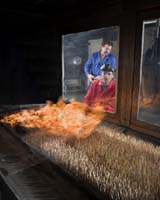
Redondo Beach CA (SPX) Aug 23, 2006 A wind-aided fire spread test tunnel that could help the world's scientists better predict and understand wildfires has been refurbished and upgraded by Northrop Grumman to support advanced global environmental programs. The tunnel is capable of simulating a wide variety of conditions that can affect the behavior of a fire and allows operators to vary the type of fuel, topography, and wind strength that affect fire propagation. Its highly controlled environment provides accurate and repeatable scientific data, enabling researchers to validate tests and analyze data for the benefit of the scientific community. "Our tunnel allows us to develop quantitative values for how a fire will behave that will help to improve fire modeling," said Leo Andreoli, director, environmental systems, Northrop Grumman Space Technology. "The resulting data will be useful for firefighters on the ground, for weather forecasters and for scientists studying climate trends. Smoke from fires can travel hundreds or even thousands of miles, profoundly affecting the atmosphere, people, wildlife and plants." The tunnel itself is one meter wide and five meters long (3.28 feet by 16.4 feet). A blower at one end pushes a uniform stream of low-turbulence air over a fuel bed, which looks like a set of vertically mounted toothpicks on the floor of the tunnel. The fuel is ignited via a propane igniter, which lights the first or upwind-most rows. During a test burn, the edge of the tunnel's movable ceiling is positioned even with the front of the fire through the use of a video camera. Two sets of strategically placed thermocouples measure the temperature of the fire and how fast it spreads. One side of the tunnel features five large heat-resistant windows, and three meters (9.84 feet) above the end of the tunnel an exhaust hood releases hot gases. Two video cameras record every test burn. Fuel beds can vary in thickness, size, height and moisture content and structures can also be simulated as part of a fuel bed. For example, a fuel tunnel test burn can mimic a Southern California chaparral-like fire using extremely dry wood. Nearly any condition can be tested -- the company's machine shop can replicate just about any fuel bed needed. Future plans include expanding the scope of the tunnel's capabilities by making modifications that will allow for variable slopes, air moisture content and the addition of fire suppressants. The most unique feature of the tunnel is its movable ceiling, which allows buoyant fire-front gases to rise with minimum obstruction and maintains a controlled testing environment by managing the volume of heat and released gases generated during a test burn. Originally used about 20 years ago to study shockwaves and fires from nuclear blasts, the tunnel was refurbished this year to support environmental systems, applications and government agencies such as the National Oceanic and Atmospheric Administration that would benefit from the tunnel's observable data and analysis. In addition, the tunnel will be able to support programs such as the Global Environmental Observation System of Systems (GEOSS) to more effectively monitor forest and local fires and predict the effect of air quality on sensitive populations. GEOSS is a 10-year international plan to provide unprecedented access to and use of global Earth observation information to track, predict and address threats to the environment. Community Email This Article Comment On This Article Related Links Northrop Grumman Forest and Wild Fires - News, Science and Technology
 Fires Still Ravaging Iberian Peninsula As Death Toll Rises
 Santiago De Compostela, Spain (AFP) Aug 07, 2006
Forest fires that have left three dead were encroaching Monday on the northwestern Spanish city of Santiago de Compostela, whose historic medieval centre attracts thousands of summer tourists. |
|
|

| The content herein, unless otherwise known to be public domain, are Copyright 1995-2006 - SpaceDaily.AFP and UPI Wire Stories are copyright Agence France-Presse and United Press International. ESA PortalReports are copyright European Space Agency. All NASA sourced material is public domain. Additionalcopyrights may apply in whole or part to other bona fide parties. Advertising does not imply endorsement,agreement or approval of any opinions, statements or information provided by SpaceDaily on any Web page published or hosted by SpaceDaily. Privacy Statement |