
 |
 |
 |
 |
 |
 |
 |
 |
 |

 |
Northrop Grumman KC-45: Why We Won - Strengths And Weaknesses
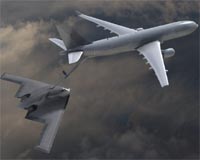
Washington DC (SPX) May 20, 2008 The U.S. Air Force found Northrop Grumman's bid to build the next generation of aerial refueling tankers superior to Boeing's in four of the five most important selection criteria. Despite this fact, the losing bidder wants the Government Accountability Office to overturn the Air Force decision to award the contract to Northrop Grumman even though the Air Force conducted what even Boeing described as a fair, open and transparent bidding process. Here is another reason Northrop Grumman won, drawn from a list of facts included in a redacted version of a protected Air Force selection document.
Strengths and Weaknesses But discriminators are not just "added up" - they vary greatly in significance. Instead of focusing on the most important discriminators, Boeing is counting items that the Air Force judged were much less critical to the KC-X's core mobility mission. In all, the Air Force identified approximately 800 requirements of varying importance. And the Air Force Request For Proposal (RFP) made clear that it considered Aerial Refueling and Airlift to be the two most important performance criteria. In these critical categories - which go to the heart of the KC-X mission - Northrop Grumman was clearly superior to Boeing, attaining a two-to-one advantage in key discriminators. Where were Boeing's advantages? They were in less critical areas like having more interior electrical outlets, better flight deck seats, and the ability to carry secondary, rarely-used fuels - like Swedish Kerosene. How do more electrical outlets stack up against increased fuel offload over range? How do better flight deck seats compare to greater airlift capability? The conclusion is obvious. The Air Force made clear what its priorities were in the RFP, rated the two competitors, and selected the KC-45. Community Email This Article Comment On This Article Share This Article With Planet Earth
Related Links The Military Industrial Complex at SpaceWar.com Learn about the Superpowers of the 21st Century at SpaceWar.com
 Possible 4.5 billion dollar fighter sale to Romania: Pentagon
 Washington (AFP) May 19, 2008
The Pentagon notified Congress on Monday of the possible sale of 48 F-16 fighters to Romania as part of a deal valued at 4.5 billion dollars. |
|
|

| The content herein, unless otherwise known to be public domain, are Copyright 1995-2007 - SpaceDaily.AFP and UPI Wire Stories are copyright Agence France-Presse and United Press International. ESA Portal Reports are copyright European Space Agency. All NASA sourced material is public domain. Additional copyrights may apply in whole or part to other bona fide parties. Advertising does not imply endorsement,agreement or approval of any opinions, statements or information provided by SpaceDaily on any Web page published or hosted by SpaceDaily. Privacy Statement |
 del.icio.us
 Digg
Digg Reddit
 YahooMyWeb
 Google
 Facebook