|
 |
 |
 |
 |
 |
 |
 |
 |

 |
Northrop Grumman Establishes Directed Energy Systems Unit
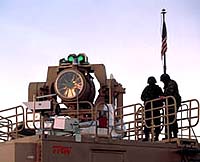
Redondo Beach CA (SPX) Feb 09, 2005 Northrop Grumman has established a new business area - Directed Energy Systems - to help transition high-energy laser systems from the laboratory to warfighters, the most advanced of which will be able to engage mortars, rockets, artillery and other threats to protect U.S. and allied military and civilian populations and assets. Established at the company's Space Technology sector, DES positions the company to better take advantage of upcoming opportunities in directed energy applications. In 2004, the Airborne Laser (ABL) program achieved 'first light' of the Northrop Grumman-built, megawatt-class laser, and the Tactical High Energy Laser (THEL) testbed proved its versatility by repeatedly shooting down mortars and large-caliber rockets in-flight. "Because of the recent successes in proving the technology and engineering behind high-energy lasers, we believe the time has come to put these speed-of-light defensive capabilities into the hands of our warfighters," said Alexis Livanos, president of Northrop Grumman Space Technology. "Northrop Grumman's high-energy laser and active protection expertise will help our nation create operational systems for both today and the future. We have world-class technology and an unparalleled team of experts in this field. "By leveraging those assets with the breadth of Northrop Grumman's related capabilities in platforms, systems integration and other directed-energy technologies, we provide a tremendous asset to our government customers in addressing our nation's battlefield and area defense needs," Livanos added. Art Stephenson, a 28-year company veteran and former director of NASA's Marshall Space Flight Center, has been named vice president of the DES unit. Stephenson, 62, is responsible for Northrop Grumman's work on chemical lasers, solid-state lasers and rocket-based engagement systems. Chemical laser programs include the ABL and the THEL testbed. Solid-state lasers include the Joint High Power Solid-State Laser and the Strategic Illuminator Laser. Rocket-based engagement systems include the Active Protection System - a radar-commanded, point-and-shoot system that can detect, track, intercept and defeat threats at a distance sufficient enough to ensure combat vehicles' survival on the battlefield. The new business area includes affiliates Cutting Edge Optronics in St. Charles, Mo., and SYNOPTICS in Charlotte, N.C., both of which produce laser materials and components. "Our work on chemical lasers as part of the THEL program has produced derivatives that are ready for deployment," Stephenson said. "These lasers are the pathfinders to the military's use of directed energy to defend against the variety of attacks we're seeing today. While chemical lasers offer a starting point for incorporating directed energy weapons into security and combat operations, our solid-state lasers, though less powerful than chemical lasers today, offer our customers the promise of more flexible, ubiquitous and mobile defense systems for future years," Stephenson added. He further noted the company continues to make significant strides in its development of solid-state lasers. "Northrop Grumman is a leading supplier of the solid-state lasers used daily by our military to perform designation and range finding. Higher-power Northrop Grumman solid-state illuminator lasers, such as the Beacon Illuminator Laser for ABL, are being used now. The Strategic Illuminator Laser is only a few years away. As we look forward to weapons systems, those using very high-power lasers could be deployed in six to nine years," Stephenson explained. Northrop Grumman is developing high-energy laser systems for ground, sea, air and space applications, including the U.S. Army's THEL, which has shot down more than four dozen targets, ranging from Katyusha rockets to artillery shells, large-caliber rockets and mortar threats, as well as the laser for the U.S. Missile Defense Agency's Airborne Laser program. Community Email This Article Comment On This Article Related Links Northrop Grumman SpaceDaily Search SpaceDaily Subscribe To SpaceDaily Express Learn about laser weapon technology at SpaceWar.com
 US Army Eyes Mobile Laser Weapon For Tactical Missile Defense
 Redondo Beach - Aug 26, 2003
The U.S. Army and the Israeli Ministry of Defense (IMoD) have selected a Northrop Grumman Corporation design concept for the Mobile Tactical High-Energy Laser (MTHEL) prototype, a laser weapon capable of shooting down short-range rockets and artillery projectiles in flight. |
|
|

| The content herein, unless otherwise known to be public domain, are Copyright 1995-2006 - SpaceDaily.AFP and UPI Wire Stories are copyright Agence France-Presse and United Press International. ESA PortalReports are copyright European Space Agency. All NASA sourced material is public domain. Additionalcopyrights may apply in whole or part to other bona fide parties. Advertising does not imply endorsement,agreement or approval of any opinions, statements or information provided by SpaceDaily on any Web page published or hosted by SpaceDaily. Privacy Statement |