|
 |
 |
 |
 |
 |
 |
 |
 |

 |
Northrop Grumman-Built Antenna Deploys To Seek Water Under Mars
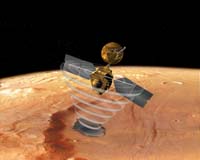
Redondo Beach CA (SPX) Sep 20, 2006 An antenna built by Northrop Grumman Corporation deployed successfully September 16 onboard NASA's Mars Reconnaissance Orbiter (MRO) for an experiment that continues the search for liquid or frozen water in the first few hundreds of feet of Mars' crust. SHARAD's antenna, weighing less than three kilograms (6.6 pounds), deployed to a length of 10 meters (33 feet) to provide the configuration required once the spacecraft reached its circular, two-hour orbit around Mars. The antenna was built by Astro Aerospace, a business unit of Northrop Grumman's Space Technology sector, for the Italian Space Agency's SHAllow RADar (SHARAD) experiment. The SHARAD experiment was built by Alcatel Alenia Space Italia and flown on the NASA spacecraft. NASA's Jet Propulsion Laboratory, operated by the California Institute of Technology, manages the MRO mission for NASA's Science Mission Directorate. "This represents another successful on-orbit achievement by a Northrop Grumman system, adding to an impressive record of more than 2,000 flawless deployments," said Tom Romesser, vice president of technology development for Northrop Grumman Space Technology. "Astro Aerospace alone, among designers and manufacturers of space deployables, has a 100 percent success rate on hundreds of flight-specific deployable units." SHARAD will probe Mars' subsurface using radar waves using a 15-25 MHz frequency band to get the desired high depth resolution. The radar wave return, which is captured by the SHARAD antenna, is sensitive to changes in the electrical reflection characteristics of the rock, sand, and any water present in the surface and subsurface. Water, like high-density rock, would have a very strong radar return. Changes in the reflection characteristics of the Martian subsurface, such as layers deposited by geological processes over the life of the planet, also can be detected. This antenna uses a similar technology to the MARSIS antenna built by Astro Aerospace for the European Mars Express spacecraft. Last year, the MARSIS antenna deployed to 40 meters (132 feet) length onboard the Mars Express once it entered the desired orbit around Mars. For more than 40 years, Northrop Grumman's Astro Aerospace has pioneered the technology of space deployable structures including AstroMesh furlable antennas and reflectors, truss masts, telescopic booms, storable tubular extendible members and planar-array deployment. Community Email This Article Comment On This Article Related Links Mars Reconnaissance Orbiter Mars News and Information at MarsDaily.com Mars News and Information at MarsDaily.com Lunar Dreams and more
 Opportunity High Tails It To Victoria Via A Rock At Emma Dean Crater
 Pasadena CA (SPX) Sep 18, 2006
Opportunity is healthy and is currently driving toward "Victoria Crater," which is a little over 100 meters (328 feet) away. On sol 936 (Sep. 11, 2006), a short bump was made to a robotic arm rock target called "Cape Faraday" near the crater "Emma Dean." Opportunity drove 1.45 meters (4.8 feet) between sols 936-940. |
|
|

| The content herein, unless otherwise known to be public domain, are Copyright 1995-2006 - SpaceDaily.AFP and UPI Wire Stories are copyright Agence France-Presse and United Press International. ESA PortalReports are copyright European Space Agency. All NASA sourced material is public domain. Additionalcopyrights may apply in whole or part to other bona fide parties. Advertising does not imply endorsement,agreement or approval of any opinions, statements or information provided by SpaceDaily on any Web page published or hosted by SpaceDaily. Privacy Statement |