|
 |
 |
 |
 |
 |
 |
 |
 |

 |
Northrop Grumman-Boeing Team Unveils Plans For Space Shuttle Successor
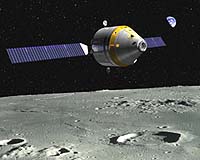
Washington DC (SPX) Oct 13, 2005 The Northrop Grumman and Boeing CEV team today unveiled its plans to design and build NASA's proposed Crew Exploration Vehicle (CEV), a modular space system intended to carry humans to the International Space Station by 2012 and back to the moon by 2018. A Northrop Grumman-Boeing team has unveiled its plans to design and build NASA's proposed Crew Exploration Vehicle, a successor to the space shuttle that will carry humans to the International Space Station by 2012 and back to the moon by 2018. Shown in these artist concepts, the new, modular space vehicle comprises a crew module reminiscent of the Apollo spacecraft, a service module and a launch-abort system. A Northrop Grumman-Boeing team has unveiled its plans to design and build NASA's proposed Crew Exploration Vehicle, a successor to the space shuttle that will carry humans to the International Space Station by 2012 and back to the moon by 2018. Shown in these artist concepts, the new, modular space vehicle comprises a crew module reminiscent of the Apollo spacecraft, a service module and a launch-abort system. The CEV comprises a crew module that builds on NASA's Apollo spacecraft, a service module and a launch-abort system. It is designed to be carried into space aboard a shuttle-derived launch vehicle The CEV will be produced both as a crewed space transportation system and as an uncrewed space vehicle capable of transporting cargo to and from the International Space Station. NASA expects to select a CEV prime contractor in the spring of 2006. According to Doug Young, program manager for the Northrop Grumman-Boeing CEV team, the team's design approach to the CEV and the overall mission architecture have been evolving over the past year. "We've been working closely with NASA to identify design options and technologies that would enable the nation to meet its space exploration goals of safety, affordability and reliability," Young said. "Early on we concluded that this modular, capsule-based approach would establish an ideal foundation for a successful, sustainable human and robotic space exploration program. It's also a system that can be designed and built today using proven technologies, which will help maintain the nation's leadership role in human space flight." While similar in shape to the Apollo spacecraft that carried astronauts to the moon in the late '60s and early '70s, the new CEV is a quantum leap forward in terms of performance, reliability and on-orbit mission capability. "The CEV we plan to build will benefit not so much from a single, technical breakthrough but rather from evolutionary improvements in structural technologies, electronics, avionics, thermal-management systems, software and integrated system- health-management systems over the past 40 years," said Leonard Nicholson, the Northrop Grumman-Boeing team's deputy program manager. According to Nicholson, the CEV offers many fundamental improvements over Apollo. Among them:
Email This Article Comment On This Article Related Links SpaceDaily Search SpaceDaily Subscribe To SpaceDaily Express Space Tourism, Space Transport and Space Exploration News
 Spicing Up Space Meals
 Los Angeles CA (SPX) Jan 04, 2006
Since its launch a year and half ago, Minimus.biz has quickly become the place to go for individual and travel size items. Last week, NASA came to Minimus.biz and purchased several different travel size condiments to send with the astronauts to the International Space Station. |
|
|

| The content herein, unless otherwise known to be public domain, are Copyright 1995-2006 - SpaceDaily.AFP and UPI Wire Stories are copyright Agence France-Presse and United Press International. ESA PortalReports are copyright European Space Agency. All NASA sourced material is public domain. Additionalcopyrights may apply in whole or part to other bona fide parties. Advertising does not imply endorsement,agreement or approval of any opinions, statements or information provided by SpaceDaily on any Web page published or hosted by SpaceDaily. Privacy Statement |