|
 |
 |
 |
 |
 |
 |
 |
 |

 |
North Korean Nuclear Test Could Unleash Ash Of Death
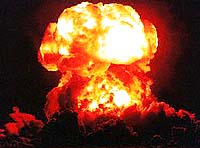
Tokyo (AFP) Oct 08, 2006 If North Korea tests an atom bomb, neighboring countries should hope its technology is sound, as a failed experiment could unleash potentially deadly radiation across Northeast Asia, experts said. A failed test would also aggravate the political fallout as China, Russia and South Korea -- which support a conciliatory approach to the communist state -- would likely suffer the most besides North Korea itself. North Korea, in a dramatic announcement last week that it will test its first atom bomb, said "safety will be thoroughly secured" -- a possible reference to an underground experiment. A series of reports based on diplomats and intelligence data have said that North Korea has drilled a hole in a mountain near the northern town of Chiktong for the nuclear test. If conducted properly, a test either inside a mountain or underground would contain radiation. But the technical prowess of the impoverished state, which apparently failed in July to test-fire a long-range missile, remains largely a mystery. Japan's conservative Sankei Shimbun newspaper said Saturday that North Korea was believed to have dug into a mountain for a test. But, citing Japanese government-backed research, it warned a surface test could bring disaster. If North Korea were to conduct its test above ground, radioactive fallout -- known as the "ash of death" -- would fly to the northern half of Japan, parts of South Korea and Russia and a vast eastern area of China within 54 hours, the daily said. Such a scenario would revive memories of the Chernobyl disaster, in which radioactive dust spread across a large swathe of Europe after explosions at a nuclear reactor in Ukraine. Up to 9,000 people are expected to die from illness due to Chernobyl, according to UN figures disputed by environmentalists. Even if North Korea intends to contain radiation, experts questioned whether it has the level of technology to conduct a nuclear test completely safely. "Their nuclear test is feared to cause radioactive contamination to some extent, considering the lack of money and technology on a radiation shield," said Koh Yu-Hwan, a professor of North Korean studies at Seoul-based Dongkuk University. "Due to geological reasons, it's hard for North Korea to dig a deep vertical underground tunnel for a nuclear test," Koh said. "We worry that the test will contaminate underground water." Narushige Michishita, a North Korea specialist at Japan's National Institute for Defense Studies, said if Pyongyang's nuclear test ends up polluting the region, ironically enough it would be its allies that would be most affected. "I don't think radiation would fly to Japan," Michishita said. "At the farthest, it would spread to China, Russia and South Korea -- the North's buddies." China, North Korea's largest provider of aid, and Russia have warned against further isolating the communist state. Both Beijing and Moscow wield veto power at the UN Security Council, where Japan and the United States have threatened a harsh response if Pyongyang goes ahead with a test. South Korea also has adopted a so-called "sunshine policy" of trying to engage its estranged communist neighbor. North Korea -- which US President George W. Bush branded part of an "axis of evil" -- said it would test a nuclear bomb due to hostility by the US. Pyongyang last year agreed in principle to give up its nuclear program in exchange for aid and security guarantees. But it walked out of six-nation talks in November to protest US sanctions on a North Korean-linked bank. Japan, the only country to have suffered nuclear attack, is the most concerned about North Korea, which fired a missile over its main island in 1998. Baku Nishio, a senior member of Japan's non-profit Citizen's Nuclear Information Center, feared long-term consequences from a North Korean test. "Radiation could start leaking out of the ground afterwards," Nishio said. "We don't even know what scale of test the North Koreans want to conduct."
Source: Agence France-Presse Community Email This Article Comment On This Article Related Links Learn about nuclear weapons doctrine and defense at SpaceWar.com Learn about nuclear weapons doctrine and defense at SpaceWar.com Learn about missile defense at SpaceWar.com All about missiles at SpaceWar.com Learn about the Superpowers of the 21st Century at SpaceWar.com
 North Korea Celebrates Kim Leadership Amid Nuclear Jitters
 Seoul (AFP) Oct 08, 2006
North Korea heaped praise on leader Kim Jong-Il on Sunday's ninth anniversary of his rise to communist party chief, but stayed silent over the regime's threat to test a nuclear bomb. Official media in Pyongyang ran editorials or commentaries praising Kim's Songun (military-first) policy, according to the North's Korean Central News Agency. |
|
|

| The content herein, unless otherwise known to be public domain, are Copyright 1995-2006 - SpaceDaily.AFP and UPI Wire Stories are copyright Agence France-Presse and United Press International. ESA PortalReports are copyright European Space Agency. All NASA sourced material is public domain. Additionalcopyrights may apply in whole or part to other bona fide parties. Advertising does not imply endorsement,agreement or approval of any opinions, statements or information provided by SpaceDaily on any Web page published or hosted by SpaceDaily. Privacy Statement |