|
 |
 |
 |
 |
 |
 |
 |
 |

 |
North Korean Missile Drives Wedge Through Asia
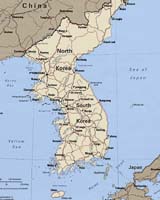
Seoul (AFP) Jul 10, 2006 North Korea's new long-range missile may have malfunctioned within seconds, but the launch has succeeded in driving a sharp wedge between countries negotiating with the communist state. Japan and the United States, which both see themselves as potential targets for Pyongyang's missiles, have stood side-by-side in demanding sanctions, an option opposed by China and Russia which dread the consequences if the regime collapses. South Korea has been caught in the middle, embarrassed that its policy of engaging its estranged neighbor failed to prevent the missile launch but resentful of former colonial power Japan's hardline stance. In Seoul, which has been in the sights of Pyongyang's missiles for decades, few believe the North is planning to lob a missile at fellow Koreans. "I'm not afraid at all," said Lee Sang-Jin, a 20-year-old student on a morning stroll with his girlfriend. "I heard about the missile but it's not aimed at South Korea. They just seemed to want to show their power to the Americans." In Tokyo, while no one is running for shelter, concern is mounting over North Korea, whose previous long-range missile in 1998 flew over Japan into the Pacific Ocean. "Japan should menace the North Koreans back," Shigeko Asai, 65, said while enjoying coffee and cake. "The Japanese have done nothing concrete since the North Koreans first launched missiles. They are too nice." Japan and South Korea are expected to bankroll any future deal with North Korea, which since November has boycotted six-nation talks on ending its nuclear drive. The North on Wednesday fired seven missiles including a new long-range Taepodong-2, which is said to be able to hit US soil but quickly crashed into the Sea of Japan (East Sea). US envoy Christopher Hill, in friendly territory in Tokyo after stops in Beijing and Seoul on an emergency tour, denied any "splintering" in nations' positions on North Korea. But just hours earlier, South Korea accused Japan of fanning tensions after Japanese Foreign Minister Taro Aso publicly mulled a preemptive strike on North Korea in a hypothetical case of an immediate nuclear threat. Robert Dujarric, a North Korea expert based in Tokyo, suspected the North Korean bravado over the missile tests was aimed at driving a wedge between its neighbors. "They hope that by making some inflammatory statements, they may generate inflammatory statements back from the US, or even better from Japan, and create a split so the South Korean response will be very moderate, if not appeasing," Dujarric said. "They could say, 'Look, we're trying to have negotiations but the US and Japan make it impossible,' and lots of South Koreans will fall for this," Dujarric said. Despite six decades of division, North and South Korea are united in their lingering bitterness toward Japan over its brutal 1910-1945 occupation of the Korean peninsula. South Korea has suspended critical humanitarian aid to the impoverished North in response to the missile tests but has stood by its "sunshine policy" launched in 2000 by the South's then president Kim Dae-Jung, who won the Nobel peace prize. But the South, which hosts some 32,500 US troops facing the North's 1.2 million-strong military, has resented criticism it has drifted from the US camp since President George W. Bush took office in 2001 and adopted a hawkish stance on Pyongyang. A senior Japanese diplomat was forced to apologize last year after his closed-door remark was leaked that Washington no longer trusted Seoul. Still, the North's provocative approach could backfire in South Korea, analysts said. The North "is not playing the South Korean card very well" and needed to give Seoul tangible signs its sunshine policy was working, said Peter Beck, the Northeast Asia project director at the International Crisis Group. "For now Seoul has no appetite to crack down in any meaningful way. But over time, the more difficult the North gets, the more trouble it puts the government in," Beck said.
Source: Agence France-Presse Community Email This Article Comment On This Article Related Links Learn about nuclear weapons doctrine and defense at SpaceWar.com Learn about missile defense at SpaceWar.com All about missiles at SpaceWar.com
 Taiwan To Test Fire Cruise Missile Capable Of Hitting China
 Taipei (AFP) Jul 06, 2006
Taiwan plans to test-fire a cruise missile capable of hitting rival China despite concerns from the United States, a report here said Thursday. The cruise missile, with a range of 600 kilometers (360 miles), will be test-fired at a ceremony in September attended by President Chen Shui-bian in the south of the island, the ettoday.com online newspaper said. |
|
|

| The content herein, unless otherwise known to be public domain, are Copyright 1995-2006 - SpaceDaily.AFP and UPI Wire Stories are copyright Agence France-Presse and United Press International. ESA PortalReports are copyright European Space Agency. All NASA sourced material is public domain. Additionalcopyrights may apply in whole or part to other bona fide parties. Advertising does not imply endorsement,agreement or approval of any opinions, statements or information provided by SpaceDaily on any Web page published or hosted by SpaceDaily. Privacy Statement |