|
 |
 |
 |
 |
 |
 |
 |
 |

 |
North Korea Talks Remain In Fog Of Hot Air
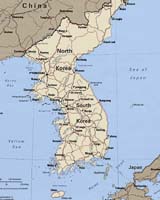
UPI Correspondent Seoul (UPI) Feb 21, 2007 As delegates prepare for the March round of negotiations to end North Korea's nuclear program, how Pyongyang will actually go about dismantling its nuclear arsenal remain unclear. The United States, Russia, China, South Korea, and Japan are determined that North Korea must report all of its nuclear weapons programs, including suspected programs with highly-enriched uranium and dismantle all of them. But North Korea largely remains in denial of the very existence of any uranium program. Analysts cite a loophole in last week's nuclear disarmament deal that did not explicitly ban North Korea from pursuing uranium-based weapons, and failed to address existing plutonium-based weapons, forecasting tough haggling in the next round of six-nation talks on the years-long nuclear standoff. Nuclear negotiators from six countries are scheduled to gather in Beijing on March 19 to discuss how to implement the groundbreaking nuclear deal reached at the previous round of six-party talks last week. Under the deal, Kim Jong-Il's regime will shut down and seal its plutonium-producing reactor at Yongbyon within 60 days and admit U.N. nuclear inspectors. In return, it will receive 50,000 tons of heavy fuel oil or equivalent assistance. The energy-starved communist nation will also receive an additional 950,000 tons of heavy fuel oil or equivalent as soon as it completes the "disabling" of "all existing nuclear facilities, including graphite-moderated reactors and reprocessing plant" by an unspecified date. The deal also calls for the United States and Japan to start talks with North Korea aimed at normalizing diplomatic ties, which could address Pyongyang's security fears which allegedly forced it to seek nuclear weapons. The accord, however, has sparked a debate in South Korea and the United States for failing to deal directly with the North's uranium-based program, the main source of the ongoing nuclear crisis which erupted in late 2002 following U.S. accusations that Pyongyang was running a clandestine weapons program based on HEU in addition to its acknowledged plutonium program in violation of a 1994 nuclear deal. The United States believes the North purchased large quantities of centrifuge-related equipment in 2001 to produce atomic bombs. Large scale use of centrifuges is necessary to enrich enough uranium for use in a nuclear reactor. Highly enriched uranium is required to make nuclear weapons. South Korea's intelligence agency also believes North Korea is running a clandestine uranium-enrichment program. "We believe (the uranium program) exists (in the North)," Kim Man-bok, head of the National Intelligence Service, told a parliamentary committee. Seoul officials point out that the North must eventually submit a list of its nuclear facilities and programs, including any uranium-based one. The Feb 13 accord requires the North to report its uranium-based weapons programs, if any, Foreign Minister Song Min-Soon said in a news briefing on Wednesday. "The invariable principle is that North Korea will dismantle all of its nuclear-related activities whether they are nuclear weapons or nuclear programs," he said. But the North has raised doubts about its interpretation of the nuclear deal as Pyongyang's state media described the accord as only involving a "temporary suspension of the operation of its nuclear facilities," instead of "disablement" of nuclear facilities, as stipulated in the agreement. "At the talks the parties decided to offer economic and energy aid equivalent to one million tons of heavy fuel oil in connection with the DPRK (North Korea)'s temporary suspension of the operation of its nuclear facilities," the North's officials Central News Agency said, in reporting about the results of the six-nation talks in Beijing. Pyongyang has also long denied having a uranium-based program, refuting U.S. accusations. Former U.S. Defense Secretary William Perry, who is on a visit to Seoul, told journalists that the uranium enrichment program issue could lead to the collapse of nuclear negotiations.
Source: United Press International Community Email This Article Comment On This Article Related Links Learn about missile defense at SpaceWar.com Learn about nuclear weapons doctrine and defense at SpaceWar.com All about missiles at SpaceWar.com Learn about the Superpowers of the 21st Century at SpaceWar.com Learn about nuclear weapons doctrine and defense at SpaceWar.com Learn about missile defense at SpaceWar.com All about missiles at SpaceWar.com Learn about the Superpowers of the 21st Century at SpaceWar.com
 Military Operations Outside Iraq Unacceptable
 Moscow (RIA Novosti) Feb 21, 2007
The Russian foreign minister said Wednesday U.S.-led multinational foreign forces in Iraq must not conduct military operations outside the country, including against Iran. "The multinational force in Iraq should abide strictly by the UN Security Council's mandate, which does not provide for any operations outside the country," Sergei Lavrov said in an interview with weekly Lebanese magazine Al-Watan Al-Arabi. |
|
|

| The content herein, unless otherwise known to be public domain, are Copyright 1995-2006 - SpaceDaily.AFP and UPI Wire Stories are copyright Agence France-Presse and United Press International. ESA PortalReports are copyright European Space Agency. All NASA sourced material is public domain. Additionalcopyrights may apply in whole or part to other bona fide parties. Advertising does not imply endorsement,agreement or approval of any opinions, statements or information provided by SpaceDaily on any Web page published or hosted by SpaceDaily. Privacy Statement |