|
 |
 |
 |
 |
 |
 |
 |
 |

 |
North Korea Policy Options
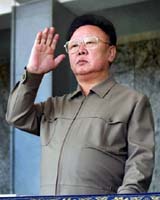
UPI Outside View Commentator Washington (UPI) Nov 24, 2006 In Iraq, regime change -- even when it involved the fall of a dictator whom President George W. Bush called a member of the "axis of evil" -- created many unexpected and costly problems. The same thing could happen if regime change comes to North Korea. The time to begin preparing for these problems is now. No tears would be shed around the world if nuclear-armed axis of evil dictator Kim Jong-Il lost power in North Korea. But those longing to see Kim deposed should remember the old saying: "Be careful what you wish for, it may come true." The fall of the self-styled "dear leader" of North Korea would have big minuses as well as plusses not just for America but for neighboring China, South Korea, Japan and other nations. Like a collapsing skyscraper, a collapsing North Korean regime could cause a lot of damage to everything around it. In his confrontation with the United States, United Nations and other countries over his development and testing of nuclear weapons, Kim is well aware of the damage his fall could cause -- and the fear this generates. In fact, this fear factor is a source of his strength. When nations worry that a post-Kim North Korea would be even more dangerous than North Korea today, their desire to topple Kim cools considerably. Discussing the fall of Kim and his Stalinist dictatorship is no academic exercise. North Korea is an economic basket case, mired in poverty and kept going only because of foreign aid -- primarily from China and South Korea. The United Nations arms sanctions on the North and economic sanctions by other nations could put enough pressure on North Korea to cause a worsening of conditions for its people beyond the breaking point, leading to a North Korean effort to overthrow Kim in a coup. Cornered and desperate to stay in power, Kim could use nuclear blackmail to demand billions in aid and massive concessions from other nations to keep him in office. Failing to get that, and knowing he was doomed, it is not inconceivable that Kim could make good on his threat to turn Seoul into a "sea of fire" with a conventional or even nuclear attack as a final act of revenge, killing hundreds of thousands of people or more. Then what happens if Kim finally is ousted? A successor North Korean regime could come into place, but there is little likelihood such a government would have more favorable policies or even be as stable as the Kim Jong-Il government. Continued instability could lead to a series of North Korean regime collapses and revolving door governments. With a small nuclear arsenal and a huge army at their disposal, each of these governments would pose a threat of war to its neighbors. If a successor North Korean regime fails to restore order and prevent economic collapse in the communist nation, North Korea could follow the path of East Germany and unify with its capitalist, prosperous sister state -- in this case, South Korea. But while unification seems like a happy ending where freedom triumphs, a unified Korea could be just the beginning of a new nightmare. Millions of refugees would almost certainly flee the poverty and misery of what had been North Korea for the prosperous South and for China. South Korean experience with North Korean refugees suggests that these indoctrinated refugees would not be easily absorbed into the South Korean economy.
First of two parts. Bruce Bennett is a senior policy analyst at the Rand Corp., a nonprofit research organization. United Press International's "Outside View" commentaries are written by outside contributors who specialize in a variety of important issues. The views expressed do not necessarily reflect those of United Press International. In the interest of creating an open forum, original submissions are invited.
Source: United Press International Community Email This Article Comment On This Article Related Links Learn about nuclear weapons doctrine and defense at SpaceWar.com Learn about nuclear weapons doctrine and defense at SpaceWar.com Learn about missile defense at SpaceWar.com All about missiles at SpaceWar.com Learn about the Superpowers of the 21st Century at SpaceWar.com
 Bullish North Korea Says Ready For Nuclear Talks
 Beijing (AFP) Nov 28, 2006
North Korea is ready for six-nation talks on its nuclear program after winning extra bargaining clout with its first atomic test, its top negotiator said Tuesday as he met US and Chinese diplomats. Kim Kye-Gwan headed straight into meetings here with Christopher Hill, his US counterpart at the six-nation forum, and chief Chinese negotiator Wu Dawei after flying into the Chinese capital early Tuesday. |
|
|

| The content herein, unless otherwise known to be public domain, are Copyright 1995-2006 - SpaceDaily.AFP and UPI Wire Stories are copyright Agence France-Presse and United Press International. ESA PortalReports are copyright European Space Agency. All NASA sourced material is public domain. Additionalcopyrights may apply in whole or part to other bona fide parties. Advertising does not imply endorsement,agreement or approval of any opinions, statements or information provided by SpaceDaily on any Web page published or hosted by SpaceDaily. Privacy Statement |