|
 |
 |
 |
 |
 |
 |
 |
 |

 |
North Korea Plays A New Missile Card
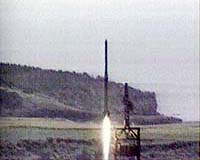
Seoul (UPI) Jun 20, 2006 Will North Korea launch a long-range ballistic missile that could reach the continental United States at grave cost? Or is the missile threat another card to win concessions from the United States as its nuclear program has failed to attract U.S. attention? Some U.S. and Japanese officials believe North Korea is poised to launch because the Taepodong-2 missile has been fueled, while satellite photos show launch preparations at the Musudan-ri missile facility in North Hamgyong province in northeastern North Korea. But South Korean officials and analysts say North Korea will not actually fire the missile because it is sure to trigger strong punitive measures from the international community, which could threaten the economic survival of the communist regime already suffering from U.S.-led financial sanctions over its nuclear program and financial illegalities. Moreover, it is believed that China opposes the prospective missile launch as it could be used by Japan to step up its efforts toward its missile defenses and stronger security ties with the United States. "The North's missile threat seems aimed at gaining leverage as its nuclear card is losing effectiveness. With the missile card in hand, the Kim Jong Il regime seeks to have direct talks with the United States," said Koh Yu-hwan, a North Korea specialist at Dongguk University in Seoul. "If North Korea fires the missile, it is aimed at tightening its grip on the people. This indicates a crack in the North's social control system and serious conflicts among power elite," he said. According to intelligence sources, the North's state control has been weakened since its economic reform measures in 2002, which brought about negative fallout, including tremendous inflation. North Korea's ruling elite, mostly Workers' Party members, have also increasingly complained about the country's economic reform measures as eroding the privileges they have enjoyed for the past decades, intelligence officials have said. "North Korea may use a missile launch to create a war-like mood in the society to tighten its control over the people and cope with mounting outside pressure," the source said. But South Korean officials said North Korea would not press ahead with a missile launch, if only for domestic reasons, because it would lead to punitive measures from the United States and Japan. If the North launches a long-range missile, South Korea would be left with no option but to join sanctions on Pyongyang and review its economic assistance, which has helped the North Korean economy stay afloat, officials say. "The North seems to be resorting to a new round of brinkmanship to break the deadlock in the nuclear talks and emerge from U.S. sanctions," a Seoul government official said. "The missile move is a grab for Washington's attention as its focus was primarily on Iran's nuclear issue and a way to press the United States to agree to direct talks," he said. The North's missile threat comes after its proposal of direct talks with the United States was turned down earlier this month. On June 1, North Korea officially invited Christopher Hill, chief U.S. nuclear negotiator, to visit Pyongyang for discussions, but the United States has rejected the offer. North Korea has long insisted a resolution to the nuclear crisis could come only through direct talks between Pyongyang and Washington, calling for a non-aggression pact with the United States. But Washington has shunned a bilateral meeting with the North. The United States had previously been engaged in direct talks with the North that led to a 1994 deal on halting the North's nuclear drive in exchange for two nuclear reactors and other aid. But the Bush administration has sought a resolution within the multilateral framework after accusing the North in 2002 of pursuing a new secret uranium enrichment program in violation of the 1994 deal. In 1998, the North's missile brinkmanship succeeded in pressing the United States to join direct talks after it test-fired a long-range Taepodong-1 ballistic missile over Japan and into the Pacific Ocean. After year-long bilateral talks, Pyongyang and Washington reached a breakthrough under which the United States eased its financial sanctions on the North in return for its pledge to freeze missile activities. "With the renewed missile threat, the North wants to press the United State to ease its financial sanctions," said Kim Tae-woo, a North Korea expert at Seoul's government-run Korea Institute for Defense Analysis. Last September, the United States slapped restrictions on Banco Delta Asia, a Macau-based bank accused of laundering money for North Korea. Under the U.S. measure, BDA has cut off transactions with North Korea, which is believed to have choked Pyongyang's cash flow. The U.S. administration has also frozen the U.S.-based assets of eight North Korean companies.
Source: United Press International Community Email This Article Comment On This Article Related Links - Learn about nuclear weapons doctrine and defense at SpaceWar.com Learn about missile defense at SpaceWar.com All about missiles at SpaceWar.com Learn about the Superpowers of the 21st Century at SpaceWar.com
 US And Russian Nuclear Weapons Deal Extended
 Washington (AFP) Jun 20, 2006
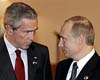
The United States and Russia have extended the US-funded program that pays for the dismantling of weapons of mass destruction inherited by Russia from the former Soviet Union, the White House said Monday. |
|
|

| The content herein, unless otherwise known to be public domain, are Copyright 1995-2006 - SpaceDaily.AFP and UPI Wire Stories are copyright Agence France-Presse and United Press International. ESA PortalReports are copyright European Space Agency. All NASA sourced material is public domain. Additionalcopyrights may apply in whole or part to other bona fide parties. Advertising does not imply endorsement,agreement or approval of any opinions, statements or information provided by SpaceDaily on any Web page published or hosted by SpaceDaily. Privacy Statement |