|
 |
 |
 |
 |
 |
 |
 |
 |

 |
North Korea Hints At Missile Talks
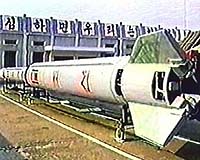
Seoul (UPI) Jun 22, 2006 As the United States prepares for punitive measures against a possible North Korean missile launch, Pyongyang hinted Wednesday that it would put off the planned flight test if Washington agrees to direct talks. Speaking to South Korean and Japanese journalists, North Korean officials confirmed that Pyongyang was preparing for a long-range missile test, calling it a "sovereign right," but the country would like to ease international concerns about its missile through dialogue with the United States. Tensions are running high in the region following U.S. intelligence reports that North Korea has fueled a Taepodong-2 missile that could reach the continental United States after loading booster rockets onto a launch pad in the North's missile site in Musudan-ri, a northeastern town facing international waters with Japan. The move is seen as a key final step before launch, as the fuel is difficult to remove, indicating that the launch is only a matter of time. The North's renewed missile threat has put the region on alert. Han Song Ryol, North Korea's deputy chief of mission at the United Nations in New York, said he was aware of concerns about the missile activity, indirectly confirming his country's missile test plan. "We are aware of the U.S. concerns about our missile test-launch," Han was quoted as saying by Seoul's Yonhap News Agency on Wednesday. "So our position is that we should resolve the issue through negotiations," he said. But he underlined the North's position that it had a "sovereign right" to develop, deploy and test-fire missiles. "It is not right that others tell us what to do about our sovereign rights," Han said. "Some say our missile test launch is a violation of the moratorium, but this is not true," he said. The North's missile-testing moratorium is effective only when negotiations to improve relations with the United States are underway, Han told Yonhap. In September 1999, North Korea declared a moratorium on missile test launches in return for a U.S. decision to ease sanctions. The deal came after the North rattled the region in August 1998 when it test-fired a Taepodong-1 missile with a range of up to 1,500 miles over Japan into the Pacific Ocean. The North maintains the launch was a multistage rocket to send a satellite into orbit. Under the "Pyongyang Declaration" signed with Japanese Prime Minister Junichiro Koizumi in September 2002, North Korean leader Kim Jong Il pledged to maintain the moratorium on missile launching in and after 2003. Li Pyong Dok, a senior official at the North's Foreign Ministry, also told a group of visiting Japanese journalists that Pyongyang did not regard itself as bound by prior agreements to refrain from missile testing. "Our actions are not bound by the Pyongyang Declaration, the joint declaration made at the six-party talks in September last year or any other statements," Li was quoted as saying by the Kyodo news agency and Asahi Shimbun. A pro-North Korea newspaper in Japan, Choson Sinbo, Wednesday published a piece by its Pyongyang correspondent saying that the launch of a rocket could take place "anytime, which can be in a month or in a year." But the newspaper, run by pro-communist ethnic Koreans in Japan, indicated that North Korea would not actually fire the missile, as it accused the United States of "manipulating" information on the missile preparations. "It is nonsensical that the United States discusses countermeasures first with other countries except for North Korea, as it makes no response to the North's inviting Christopher Hill (chief U.S. negotiator with North Korea to Pyongyang)," the paper said. Earlier this month, North Korea invited Hill to visit Pyongyang for direct talks to break the nuclear standoff, a proposal rebuffed by Washington. North Korea has insisted a resolution to the nuclear crisis will come only through direct talks between Pyongyang and Washington, and calls for a non-aggression pact with the United States. But the United States has shunned a bilateral meeting with the North, seeking a resolution in a multilateral manner, taking a lesson from the failure of the bilateral 1994 nuclear deal. Seoul-based analysts say North Korea wants to use the missile threat as a card to win a U.S. promise of direct talks. "North Korea wants to use the missile issue as a bargaining chip," said Koh Yu-hwan, a North Korea specialist at Dongguk University in Seoul. Kim Kun-shik, a professor at Kyungnam University, also described the North's missile threat as a card, calling on Hill to travel to Pyongyang to resolve the missile and nuclear tensions.
Source: United Press International Community Email This Article Comment On This Article Related Links - Learn about nuclear weapons doctrine and defense at SpaceWar.com Learn about missile defense at SpaceWar.com All about missiles at SpaceWar.com Learn about the Superpowers of the 21st Century at SpaceWar.com
 Iran Brandishes Oil Weapon In Nuclear Row
 Tehran (AFP) Jun 25, 2006
Iran on Sunday again brandished oil as a weapon in a dispute over its nuclear programme, as it continued to resist international demands to freeze sensitive uranium enrichment work. The threat came amid mounting pressure on Tehran to accept a proposal that it halt enrichment -- at the centre of fears it could acquire nuclear weapons -- in exchange for multilateral talks and a package of incentives. |
|
|

| The content herein, unless otherwise known to be public domain, are Copyright 1995-2006 - SpaceDaily.AFP and UPI Wire Stories are copyright Agence France-Presse and United Press International. ESA PortalReports are copyright European Space Agency. All NASA sourced material is public domain. Additionalcopyrights may apply in whole or part to other bona fide parties. Advertising does not imply endorsement,agreement or approval of any opinions, statements or information provided by SpaceDaily on any Web page published or hosted by SpaceDaily. Privacy Statement |