|
 |
 |
 |
 |
 |
 |
 |
 |

 |
North Korea Deal Faces First Test
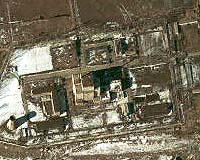
UPI Correspondent Seoul (UPI) March 13, 2007 The head of the U.N. nuclear watchdog agency embarked on a two-day tour of North Korea Tuesday in a litmus test for implementing a landmark deal on ending the communist country's nuclear weapons programs. During the visit, Mohammed El-Baradei, head of the International Atomic Energy Agency, will try to coax North Korea to allow his inspectors back into the country. He is also expected to seek a list and details of all its nuclear sites. North Korea kicked IAEA inspectors out from its nuclear complex in December 2002 and severed ties with the Vienna-based watchdog shortly after U.S. officials accused Pyongyang of running a secret uranium enrichment program in violation of the 1994 deal. North Korea has since then declared that it had finished reprocessing its spent fuel rods and finally conducted an underground nuclear test in October last year, which has put the Asian-Pacific region on full alert. After years of on-off negotiations, however, the North agreed last month on ending its nuclear weapons drive in return for massive energy and economic aid. Under the Feb. 13 nuclear accord, the North promised to shut down and seal its plutonium-producing reactor at Yongbyon, north of Pyongyang, and invite back U.N. nuclear inspectors within 60 days as part of the initial phase for dismantling its nuclear programs. In return, Pyongyang will be given 50,000 tons of heavy fuel oil or equivalent assistance. In addition, the United States and Japan accepted the North's long-standing calls for launching talks aimed at normalizing diplomatic ties. In the next phase, North Korea is required to declare all nuclear weapons, programs and facilities and "disable" existing nuclear facilities to receive an additional 950,000 tons of heavy fuel oil or other equivalent. Upon arriving in the capital, El-Baradei said he would discuss how to implement the Feb. 13 deal, voicing hope for a "positive outcome," according to China's official Xinhua news agency. He has also vowed to seek the resumption of Pyongyang's membership in the IAEA, from which North Korea withdrew in 1994. But El-Baradei warned against optimism of quick breakthroughs in ending North Korea's nuclear drive. "This is a very complex process and there is a lot of confidence that needs to be built," he said. After the North Korea visit, El-Baradei plans to meet U.S. top nuclear envoy Christopher Hill in Bejing to discuss the outcome of the visit. Hill is in Beijing for another bilateral meeting with his North Korean counterpart on diplomatic ties and for the next round of six-nation talks on the North's nuclear drive next week, also involving South Korea, China, Japan and Russia. South Korean officials have been cautiously optimistic over the implementation of the nuclear accord. "For the past one month since the Feb. 13 accord, the countries involved (in the six-party talks) have smoothly carried out their obligations," a senior government official said on condition of anonymity. South Korea's chief nuclear negotiator Chun Yung-woo also praised the six countries for "taking all possible efforts" to implement the agreement. "I believe we should be able to implement the initial steps of denuclearization without any major obstacles if (the countries) continue to do their utmost, as they have been until now," Chun told reporters. Chun will chair the first session of a six-nation working group on economic and energy aid for North Korea on Thursday. The group is one of five created as part of the Feb. 13 deal. The other four working groups would handle specific issues, such as denuclearization, regional security, Japan-North Korea relations and U.S.-North Korea ties. The working groups should be set up within 30 days from the Feb. 13 agreement. But many analysts expect obstacles to emerge after the 60-day deadline on April 14. "The fate of the Feb. 13 nuclear deal seems to be determined by whether the North shuts down its Yongbyon complex and declare all nuclear weapons as called for under the accord," said Yoon Duk-min, a researcher at the state-run Institute of Foreign Affairs and National Security.
Source: United Press International Community Email This Article Comment On This Article Related Links Learn about missile defense at SpaceWar.com Learn about nuclear weapons doctrine and defense at SpaceWar.com All about missiles at SpaceWar.com Learn about the Superpowers of the 21st Century at SpaceWar.com Learn about nuclear weapons doctrine and defense at SpaceWar.com Learn about missile defense at SpaceWar.com All about missiles at SpaceWar.com Learn about the Superpowers of the 21st Century at SpaceWar.com
 Blair Faces Key Vote On Renewing Nuclear Deterrent
 London (AFP) Mar 14, 2007
The British government faces a controversial vote in parliament on Wednesday over Prime Minister Tony Blair's plans to renew the country's independent nuclear deterrent. |
|
|

| The content herein, unless otherwise known to be public domain, are Copyright 1995-2006 - SpaceDaily.AFP and UPI Wire Stories are copyright Agence France-Presse and United Press International. ESA PortalReports are copyright European Space Agency. All NASA sourced material is public domain. Additionalcopyrights may apply in whole or part to other bona fide parties. Advertising does not imply endorsement,agreement or approval of any opinions, statements or information provided by SpaceDaily on any Web page published or hosted by SpaceDaily. Privacy Statement |