|
 |
 |
 |
 |
 |
 |
 |
 |

 |
North Korea Aid Dilemma
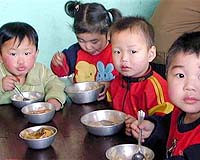
Seoul (UPI) May 17, 2006 North Korea is set to receive United Nations food aid for the next two years and rival South Korea, which has donated grain and fertilizer for years, plans to increase economic assistance. The food aid is considered vital to stave off famine in North Korea, which still suffers from acute food shortages and appears headed for another crisis. But aid programs have triggered concerns over a lack of distribution transparency within the communist country that relate to the long international standoff over its nuclear weapons program. Some experts demand the food aid be tied to the North taking fundamental steps to resolve its chronic food shortages. Last week, the U.N. World Food Program said it would resume its assistance operation in North Korea later this week to feed 1.9 million of the "most needy" people in the country for two years. The aid plan comes after North Korea agreed last week to let the WFP resume distributing food in the country, six months after Pyongyang forced the agency to leave the country in an apparent bid to block information leaks during relief workers' monitoring of where its assistance was going. In a press conference in Seoul on Friday, Tony Banbury, WFP's regional director for Asia, described the deal as "an important breakthrough" to save North Koreans from famine and malnutrition. Under the deal, the relief agency will provide 150,000 tons of food over the two years, worth $102 million, for 1.9 million of the neediest people in North Korea, according to Banbury who returned from a two-day visit to the North. Banbury stressed the severity of food shortages still lingering in the North, but said his agency has decided to reduce its food aid to 150,000 tons for two years from 500,000 tons each year because North Korea demanded the U.N. agency curtail its on-the-spot monitoring. Under the new agreement, the WFP was urged to reduce its staff to 10 from 32, forcing the agency to cut off aid. "The alternative to this was closing down the operation entirely and walking away," Banbury said. "We did not compromise on our principles. No access and no food." He said monitoring activities are necessary to ensure that the aid was not diverted for military use or sold on the black market. Banbury's comments came after the United States said it will not be taking part in WFP's resumption of food aid, citing concerns about the transparency of the North Korean government. But the WFP Asia chief called for more international efforts to ease food shortages in the North, saying the country lacks capabilities to produce enough food to feed its 23 million people. "North Korea has made strenuous efforts to increase more crop output, mobilizing many people for farming, but it lacks technology and farm machinery, such as tractors," Banbury told United Press International before leaving Seoul. Since the food crisis of the mid-1990s, North Korea says it has made agriculture its top priority, but is still suffering food shortages with no immediate signs of significant improvement. According Seoul's Unification Ministry, North Korea's grain production rose 5.3 percent to 4.54 million tons in 2005, helped by better harvests and fertilizer shipments from South Korea. But the harvest was still far short of the country's annual demand, estimated at six million tons, the ministry said. "I believe North Korea's effort to increase crop output is serious, but its lacks capabilities," Banbury said. South Korea has provided massive food and fertilizer aid to the North. It plans to donate 450,000 tons of fertilizer this year. In addition, Seoul is pushing for massive economic assistance in an effort to reduce military tensions on the peninsula and promote cross-border reconciliation. In a cautious response, the U.S. envoy on North Korean human rights, Jay Lefkowitz, raised concerns that South Korean aid to the North may help the hard-line regime, highlighting policy differences between Seoul and Washington over how to deal with Pyongyang. Some analysts say outside food aid should be used to encourage reforms and changes in the North, saying the 1995-96 food crisis has prompted the North to seek openess and limited reforms. Marcus Noland, a North Korea expert at the Institute for International Economics, said the North's food shortage was mainly caused by its rigid structure, not by natural disaster. North Korea's food problem cannot resolved without fundamental reforms, he added.
Source: United Press International Community Email This Article Comment On This Article Related Links - Learn about nuclear weapons doctrine and defense at SpaceWar.com Learn about missile defense at SpaceWar.com All about missiles at SpaceWar.com Learn about the Superpowers of the 21st Century at SpaceWar.com
 Iran says not interested in EU incentives
 Tehran (AFP) May 16, 2006
 Iran reiterated Tuesday that it was not interested in an European Union offer of incentives in return for a halt to the Islamic republic's nuclear programme. |
|
|

| The content herein, unless otherwise known to be public domain, are Copyright 1995-2006 - SpaceDaily.AFP and UPI Wire Stories are copyright Agence France-Presse and United Press International. ESA PortalReports are copyright European Space Agency. All NASA sourced material is public domain. Additionalcopyrights may apply in whole or part to other bona fide parties. Advertising does not imply endorsement,agreement or approval of any opinions, statements or information provided by SpaceDaily on any Web page published or hosted by SpaceDaily. Privacy Statement |