|
 |
 |
 |
 |
 |
 |
 |
 |

 |
Norht Korean President Stands Firm On Sanction Threat
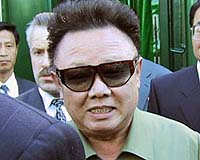
UPI Asia Correspondent Seoul (UPI) May 03, 2006 North Korean leader Kim Jong Il has recently revamped army units and industrial sites in an apparent bid to prepare for tougher U.S.-led sanctions, South Korean officials say. In particular, Kim, 64, who rules the country in the capacity of supreme military commander, has sharply increased appearances in military units, as part of his much-touted "army-first" (songun) policy, under which he has given top policy priority to military affairs, calling on its hunger-stricken people to bear economic hardships. Kim made at least 32 public appearances this year as of last week, up 35 percent from a year earlier, according to Seoul's intelligence agency. Of them, 20 activities, or 63 percent, were related to the military as Kim has pressed ahead with the "songun" policy. Five appearances were on-site guidance tours of industrial plants, and two public appearances were related to diplomacy, including a visit to China in January, among others. Noteworthy is that all of his eight public activities made in April were related to the military. In March, eight of his ten public appearances were related to the military. The North's state-run Korean Central News Agency said Kim used the visits to army units to "watch the military training and express his satisfaction to the unit commanders and soldiers who possessed the combat capacities to undertake any mission." Kim called for efforts to strengthen the units as a foundation of the military before posing for a photograph with the soldiers, KCNA said. "The soldier culture created by the People's Army is replete with the spirit of the era, militant optimism and rich emotion," the official mouthpiece said. The North's 1.1 million-strong armed forces, the world's fifth largest, are the backbone of Kim's iron-fisted rule which he inherited from his father, former North Korean president Kim Il Sung, who died in 1994. "On-site" guidance tours of army units are a main tool for Kim's military-oriented rule. Last year, Kim made a total of 131 public appearances, with 70 being related to the military. "Checking up the military's war preparedness, Kim showed his commitment to protect the system and 'songun politics' both in and outside his country," Seoul's Unification Ministry official said. The South Korean intelligence agency interpreted Kim's brisk military-related activities in recent months as an effort to cope with mounting U.S.-led pressure on nuclear and financial illegalities. "Kim's increased visits to military units seemed aimed at tightening domestic control over the people by fanning the sense of difficulties in the country," an intelligence official said. "Kim also wants to demonstrate to the outside world that he is in firm control of the country and show off his determination not to surrender to outside pressure," he said. North Korea has also vowed to put its policy priority on economic resuscitation and development of science and technology in another move to prepare for U.S.-led economic sanctions by cementing its self-reliant economy. The isolated country last month unveiled a new economic blueprint and set a target of becoming a high-technology powerhouse within two decades. To achieve the goal, the country's parliament designated scientific and technological development as one of the country's top three key national goals for the future, along with military and agricultural improvements. The North's plan for technological development came after Kim Jong Il's January tour of China's southern commercial cities, such as Shenzhen, Guangzhou and Wuhan, where the technology industry is booming -- an indication that North Korea would follow in China's footsteps by gradually introducing market forces into its shattered command economy. South Korean officials and experts said the North's efforts toward scientific development and stronger economic ties with China are aimed at building its economic potentials so that it would endure greater economic sanctions. They said North Korea has decided not to seek deals with the Bush administration waiting for its ouster. "The North's calls for economic resuscitation and stronger (a) military indicate it is bracing for U.S.-led economic sanctions by cementing its self-reliant economy and defense," a government official said.
Source: United Press International Community Email This Article Comment On This Article Related Links Follow the world's second virtual nuclear war at Nuke Wars Learn about nuclear weapons doctrine and defense at SpaceWar.com Learn about missile defense at SpaceWar.com All about missiles at SpaceWar.com Learn about the Superpowers of the 21st Century at SpaceWar.com
 UN Powers Divided Over Iran As America Threatens Sanctions
 Paris (AFP) May 03, 2006
Envoys from the top five UN powers, plus Germany, said late Tuesday that a "firm" international response was needed over Iran's nuclear programme, but remained at odds over what measures to take after a Paris meeting ended without agreement. |
|
|

| The content herein, unless otherwise known to be public domain, are Copyright 1995-2006 - SpaceDaily.AFP and UPI Wire Stories are copyright Agence France-Presse and United Press International. ESA PortalReports are copyright European Space Agency. All NASA sourced material is public domain. Additionalcopyrights may apply in whole or part to other bona fide parties. Advertising does not imply endorsement,agreement or approval of any opinions, statements or information provided by SpaceDaily on any Web page published or hosted by SpaceDaily. Privacy Statement |