|
 |
 |
 |
 |
 |
 |
 |
 |

 |
No Sweat With Personal Aircon
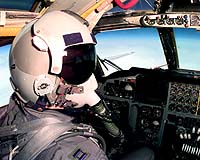
Patuxent River - Apr 30, 2003 ONR looks at a wearable personal air conditioner Navy and Marine Corps pilots operating in desert environments know heat. Their core body temperature can reach 102 degrees and higher on standard flight missions over desert regions. "This is a terrific problem that is exacerbated when they wear chem suits and body protection," says ONR Program Manager Commander Dave Street. "Aviators are threatened with heat stress and even heat stroke if such conditions are endured over long periods." The Naval Air Systems Command at Patuxent River, Maryland (NAVAIR), is developing what may prove the answer. The chest-mounted air-conditioning system is a battery operated device that draws ambient air over a small tank of water. Heat is extracted because of the temperature difference between the air and water. Water vapor forms, and is drawn off to flow over a bed of zeolite -- a silica-based compound -- which adsorbs it. When the unit's fan is turned on, the now cold air is blown out at a rate of 300 liters a minute, reducing the ambient air temperature around the aviator's chest and head area by about 10 degrees Centigrade (18 degrees Fahrenheit). This will continue for up to 3 hours (as currently configured) before the zeolite is depleted. More advanced designs already under development expect to lighten APACS units while extending duration. The whole unit is only about the size of a laptop computer, and weighs about 10 lbs. It is designed to fit within the front flap of the aviator's flight vest, and is curved to body contour. It is independent of the aircraft's power � so can be used even when the pilot is dismounted � but can also be hooked up to the aircraft power. And, the stored heat in the zeolite pack can also be used for heating if necessary, as when desert temperatures drop steeply at night. Bill Reason, an engineering technician at NAVAIR, envisions that the system will be integrated with body protection as well as cooling, and has a patent on this aspect of the system. "This makes sense," he says, "since the device sits over vital body organs. We're calling it 'cooled armor." Dr. Jonathan Kaufman, NAVAIR program manager for APACS, says the system is fully integrated with the Helicopter Aircrew Integrated Life Support System, an advanced aircrew clothing system NAVAIR is developing under ONR sponsorship, and may have broader military and civilian applications. "Test pilots love the concept," he says. "Heat is one of the biggest problems they have." Lieutenant Ben Teich, US Navy H-60 Sea Hawk Test Pilot, tested the device in a flight simulator at Ft. Hunt in Alabama. "One word? Cool." The U.S. Navy, which hopes the device will see deployment in the F-18 Hornets in three years, is actively seeking a partner in industry or academia to prototype the device for commercial application. Community Email This Article Comment On This Article Related Links Office of Naval Research SpaceDaily Search SpaceDaily Subscribe To SpaceDaily Express Space Tourism, Space Transport and Space Exploration News
 Spicing Up Space Meals
 Los Angeles CA (SPX) Jan 04, 2006
Since its launch a year and half ago, Minimus.biz has quickly become the place to go for individual and travel size items. Last week, NASA came to Minimus.biz and purchased several different travel size condiments to send with the astronauts to the International Space Station. |
|
|

| The content herein, unless otherwise known to be public domain, are Copyright 1995-2006 - SpaceDaily.AFP and UPI Wire Stories are copyright Agence France-Presse and United Press International. ESA PortalReports are copyright European Space Agency. All NASA sourced material is public domain. Additionalcopyrights may apply in whole or part to other bona fide parties. Advertising does not imply endorsement,agreement or approval of any opinions, statements or information provided by SpaceDaily on any Web page published or hosted by SpaceDaily. Privacy Statement |