|
 |
 |
 |
 |
 |
 |
 |
 |

 |
No Speed Limit On Mars
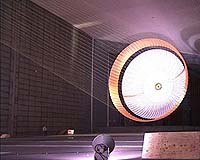
Pasadena CA (SPX) Apr 07, 2008 It's a good thing there's no speed limit on Mars, because the next parachute to fly to the red planet will deploy faster than you can legally drive on a California freeway! The chute is designed to slow the Mars Science Laboratory as it rockets through the Martian atmosphere at more than twice the speed of sound and places a car-size rover on the surface. At its carefully selected landing area, the spacecraft's rover will use an advanced suite of instruments to assess whether the environment has ever been favorable for microbial life. Engineers recently tested two parachute packing techniques in the world's largest wind tunnel at NASA's Ames Research Center. They loaded each chute into a cannon and aimed it down the middle of the tunnel. They then fired the cannon -- horizontally -- at 85 mph and let the parachute fly! Finally, they looked for damage to line attachments and other parts. All four tests were successful. They are now reviewing a veritable "jet stream" of high-speed video data to select a final parachute design for the mission, scheduled for launch in the fall of 2009. Community Email This Article Comment On This Article Related Links Mars Science Laboratory Mars News and Information at MarsDaily.com Lunar Dreams and more
 Changes to Mars Science Lab Project Respond to Cost Increases And Keep Program On Track
 Pasadean CA (JPL) Sep 19, 2007
In early June 2007, the Mars Science Laboratory project completed its project-wide Critical Design Review (CDR), which marks the completion of the project's design phase and transition into the build up of flight hardware. A key component of the CDR process was a technical risk, programmatic, and cost review, from which multiple independent cost assessments predicted that this technically challenging $1.7B planetary science rover mission's current content would cause it to exceed its budgeted development costs to launch by approximately $75M. |
|
|

| The content herein, unless otherwise known to be public domain, are Copyright 1995-2007 - SpaceDaily.AFP and UPI Wire Stories are copyright Agence France-Presse and United Press International. ESA Portal Reports are copyright European Space Agency. All NASA sourced material is public domain. Additional copyrights may apply in whole or part to other bona fide parties. Advertising does not imply endorsement,agreement or approval of any opinions, statements or information provided by SpaceDaily on any Web page published or hosted by SpaceDaily. Privacy Statement |