|
 |
 |
 |
 |
 |
 |
 |
 |

 |
No Letup In Concerns Over China's Military Buildup: US Experts
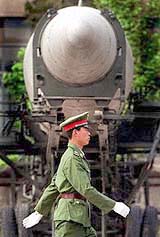
Washington (AFP) Oct 21, 2005 China is doing little to ease concerns over its rapid military buildup which is threatening American dominance in a wide range of areas, from Asian sea-lanes to outer space, US experts said Friday. Defense Secretary Donald Rumsfeld went on a maiden trip last week to Beijing to directly express US worries over China's growing military power but the experts felt the assurances he received had failed to lift long-held suspicions. While Chinese leaders allowed an unprecedented visit for Rumsfeld to the Strategic Rocket Forces headquarters in Beijing, he was not be allowed into the national military command center, the Chinese version of the Pentagon. "The Chinese in their own context made a small step forward but in reality there is no indication they are ready to embark on a new era of military transparency in the American or European sense," said Richard Fisher of the US-based International Assessment and Strategy Center. "Not only can Chinese nuclear missiles now target the continental United States; the whole configuration of the new Chinese force is clearly designed with the United States as the hypothetical enemy," Fisher said. Randall Schriver, a senior State Department official who was in charge of East Asian policy until early this year, said that "the core issue of our concerns over China's military buildup and its transparency remains unresolved" despite Rumsfeld's rare trip. While the US defense chief maintained that Beijing's military expenditure was two to three times greater than publicly acknowledged, his Chinese counterpart, Cao Guangchuan, denied any understatement of military spending. Specific concerns about the lack of transparency in China's military budget and capability were also not addressed, including the deployment of medium- and short-range missiles that can hit US airbases. Some experts believe China will develop a world-class defense industry within the next 10 to 15 years and seeks to replace the United States as the preeminent power in the Pacific - even globally. By some estimates, China now has the worlds third-largest defense budget, after the United States and Russia, spending from 70 billion to 90 billion dollars per year. But China says defense spending would be just 30 billion dollars this year. "I think it was good for the Chinese to hear directly from the secretary of defense as he actually in many ways was speaking for more than the United States," said Peter Brookes, a former US deputy assistant secretary of defense. "There are concerns about the transparency of China's military budget and its growth from others in the region who are nervous as well, including Japan, Taiwan and even Southeast Asia, but reluctant to speak up about it," he said. China argues its military budget is dwarfed by US military spending, which last year totalled 440 billion dollars, and its main preoccupation is to lift living standards of the poor in the world's most populous nation. "But what you are seeing are capabilities to, in fact, deny the United States from projecting power in the region," said Dan Blumenthal, a former senior director for China and Taiwan in the US Secretary of Defense's office. "So you have this disconnect between what China says it is doing and what it is actually doing," he said. One area of concern that has given the United States sleepless nights is what Blumenthal calls China's anti-access capabilities. "China is developing military capabilities that make it much more difficult for the United States to access hot spots in the region and, therefore, to meet its various defense commitments which have underguarded security order in the region for half a century," he said. Beijing has deployed various classes of destroyers with cruise missiles that can fire upon US carrier battle groups, "which is a matter of great concern," he said. In addition, Blumenthal said, China's deployment of diesel submarines made it "much more difficult and complicated for US carrier battle groups to get into areas that they need to get into." China is also accused of using its manned space program to achieve its military ambitions. "Every mission performed either electronic or military surveillance for the PLA (People's Liberation Army) but China is loathe to admit, from the very inception, that its manned space program has directly served military purposes," Fisher said. Brookes said that the United States's immediate concern is that China will try to use its new military might on Taiwan, which Beijing considers a renegade province, to effect unification. In addition to Beijings growing conventional military capabilities, China has as many as 750 ballistic missiles aimed at Taiwan, according to a recent Pentagon report. Many of them are reportedly also capable of striking US forces stationed in Japan. Community Email This Article Comment On This Article Related Links SpaceDaily Search SpaceDaily Subscribe To SpaceDaily Express China News from SinoDaily.com
 China Wants To Expand Sino-US Military Relations
 Beijing (AFP) Jan 10, 2006
China is ready to expand its military relations with the United States, Chinese Defense Minister Cao Gangchuan said on Tuesday. |
|
|

| The content herein, unless otherwise known to be public domain, are Copyright 1995-2006 - SpaceDaily.AFP and UPI Wire Stories are copyright Agence France-Presse and United Press International. ESA PortalReports are copyright European Space Agency. All NASA sourced material is public domain. Additionalcopyrights may apply in whole or part to other bona fide parties. Advertising does not imply endorsement,agreement or approval of any opinions, statements or information provided by SpaceDaily on any Web page published or hosted by SpaceDaily. Privacy Statement |