|
 |
 |
 |
 |
 |
 |
 |
 |

 |
Niger Paves Over Its Garbage Problem With Plastic-Bag Bricks
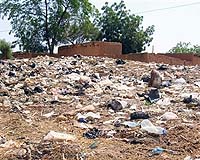
Niamey, Niger (AFP) Nov 27, 2005 It's a familiar joke across Niger that the national bird of the northwest African desert state is a black plastic bag, winging its way from market stall to trash heap to flock to the bare-branched trees around the dusty capital. In an effort to clean up its capital city and surrounding countryside for a hoped-for tourist boom, Niger is following the example set in Europe and around Africa by trying to curb the pollution caused by the ubiquitous single-use plastic bag. Kenya and South Africa have made the thin and flimsy plastic bag illegal, while in Benin, plastic bags are recycled to make colourful bracelets or handbags. But for the rest of the world, plastic bags are now consumed in staggering numbers and are responsible for massive disposal problems including unsightly litter and flooding. Made of polyethylene, they are also hazardous to manufacture and take up to 1,000 years to decompose. Rather than going to a ban or to bangles, Niger is turning its bags into filler for its perpetually crumbling roads. In an experimental project financed by the European Union, bricks of the plastic sacks are being used to fill potholes around Niamey. The government of Niger buys used plastic bags for 25 CFA francs, (about three cents) per kilo, then compresses them with a new ceramic mold technology and binds them into bricks. "Weve found a system that works remarkably well," explained EU expert Paolo Gigli. "The bags are melted and transformed into bricks with a cement mold, which saves time and money. The plastic bricks are then used to fill a pothole, and covered with earth or cement." Gigli said the cost of the bricks is but a fraction of traditional road works, allowing the world's poorest country to do more to restore its haphazard road network. An experimental batch was used to fill a pothole the size of a car in downtown Niamey in May. The covered area show no sign of erosion or weather damage, although the plastic bricks have not yet had to withstand extensive friction. "We know this system is perfect for roads with little traffic, and we suspect it will hold up well to heavier trucks and buses," said Gigli. "Only time will tell." To pave an entire kilometer of road will take roughly 40 tonnes of the molded bags and in just five months, more than 600 tonnes of bags have been collected. "We can fit 45 plastic bricks in one square meter, costs are minimal, jobs are created and roads are improved," said Gigli. But the bricks should not be seen as paving Niger's streets with gold, nor as a magic bullet for the plastic problem, he warned. "Plastic bags are not about to disappear if they remain cheap to make, readily available to shoppers, and simple to toss out into the street," he said. Community Email This Article Comment On This Article Related Links SpaceDaily Search SpaceDaily Subscribe To SpaceDaily Express Africa News - Resources, Health, Food
 Report Calls For IT Education In Africa
 Washington (UPI) Nov 29, 2005
Even in countries that lag behind in the information technology sector, there is a clear understanding that the gap between the rich and poor will only increase unless that IT divide is addressed. |
|
|

| The content herein, unless otherwise known to be public domain, are Copyright 1995-2006 - SpaceDaily.AFP and UPI Wire Stories are copyright Agence France-Presse and United Press International. ESA PortalReports are copyright European Space Agency. All NASA sourced material is public domain. Additionalcopyrights may apply in whole or part to other bona fide parties. Advertising does not imply endorsement,agreement or approval of any opinions, statements or information provided by SpaceDaily on any Web page published or hosted by SpaceDaily. Privacy Statement |