|
 |
 |
 |
 |
 |
 |
 |
 |

 |
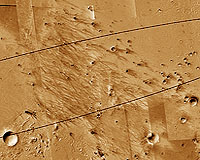
Next stop: Gusev Crater Mars
Pasadena (AFP) Jan 03, 2004 A US-made robotic rover was to touch down on the bumpy surface of Mars early Sunday after a seven-month space odyssey, to begin the most ambitious exploration of the red planet ever undertaken. It will complete the 300 million mile (500 million km) journey with a blistering six-minute plunge through the Martian atmosphere, during which the Mars Exploration Rover (MER) will decelerate from a space cruising speed of 12,000 miles (20,000 km) per hour to zero at the 0435 GMT. "It will be six minutes from hell," said NASA administrator for space science Ed Weiler, describing the descent of the first of two robots -- MER-A -- to be followed by MER-B on January 25. The robots were flying to Mars aboard two space probes, Spirit and Opportunity, launched respectively on June 10 and July 7. They are to land on opposite sides of the planet and spend three months searching for signs of life. As of late Saturday MER teams at NASA's Jet Propulsion Laboratory here were good to go. "Right now, the spacecraft's health is excellent, we've got the spacecraft all ready," said deputy mission manager Mark Adler. The calculations needed to bring the MER down in the target ellipse, 60 km (37 miles) long by three km (2 miles) wide, 15 degrees south of the Martian equator, were mind-boggling. "It's like playing golf ... where you tee off in Paris and the hole is in Tokyo," said navigation team chief Louis D'Amario. "It's the equivalent of locating something the size of a quarter in New York City, seen from Los Angeles." But, he added, the probability of hitting the ellipse was "99 percent.) D'Amario said that at 20H00 GMT Saturday, the Spirit probe was 58,000 miles (94,000 km) from the surface of Mars and "the navigation status is truly excellent." NASA describes the voyage's end game this way. Fifteen minutes before entering Mars' atmosphere, now traveling at 12,000 miles (20,000 km) per hour, Spirit will separate from its cruising stage rocket. During the first four minutes of descent, atmospheric friction will heat the lead edge of the probe's thermal shield to around 2,600 degrees F. (1,400 C). Just under two minutes from touchdown, its parachute will open. Twenty seconds later, the probe will jettison the spent lead edge of the shield, exposing the rover's protective cone, encased in in uninflated air cushions. "In the final six seconds," said NASA, "the retro rockets on the upper shell will fire and the tether (to the parachute) will be cut about 15 meters (49 feet) above the ground." During that 15 meter freefall, the air cushions will inflate and if all goes as planned the rover will a soft landing, bouncing about 15 times over a distance of a kilometer (1,000 yards) before coming to a standstill. At that point, the air cushions deflate, the three segments of the protective cone open and, over the ensuing two hours, the rover will deploy the solar panels that are to power its onboard equipment and protect it from the Martian cold. This, said Jennifer Trosper, Spirit Mission Manager for Surface Operations, will be a "critical deployment...what the rover needs to do to be in a safe mode. It ends with the deployment of the solar panels. At this point, the rover is in a power safe mode." The MER mission, at a record cost of 820 million dollars, will involve some 250 NASA specialists and researchers who over three months will micro-manage the two six-wheeled rovers, weighing 180 kgs (400 pounds) each, roughly the size of a subcompact car. This latest and most sophisticated effort to unlock the secrets of the red planet is beginning just days after the planned December 25 arrival of the ill-fated European robot Beagle 2, which has not been heard from since that date. If all goes well with the MER-A landing, NASA engineers plan soon to deploy its panoramic camera, capable of transmitting back to earth 360-degree high-resolution color photos of the Martian landscape.
Email This Article Comment On This Article Related Links Mars at JPL MERs at Cornell SpaceDaily Search SpaceDaily Subscribe To SpaceDaily Express Mars News and Information at MarsDaily.com Lunar Dreams and more
 Spirit Heading To 'Home Plate'
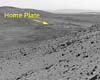 Pasadena CA (JPL) Jan 09, 2006
Last week Spirit completed robotic-arm work on "El Dorado." The rover used all three of its spectrometers plus the microscopic imager for readings over the New Year's weekend. |
|
|

| The content herein, unless otherwise known to be public domain, are Copyright 1995-2006 - SpaceDaily.AFP and UPI Wire Stories are copyright Agence France-Presse and United Press International. ESA PortalReports are copyright European Space Agency. All NASA sourced material is public domain. Additionalcopyrights may apply in whole or part to other bona fide parties. Advertising does not imply endorsement,agreement or approval of any opinions, statements or information provided by SpaceDaily on any Web page published or hosted by SpaceDaily. Privacy Statement |