|
 |
 |
 |
 |
 |
 |
 |
 |

 |
Next Station Crew to Launch Oct. 13
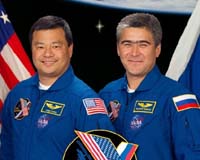
Houston TX (SPX) Oct 11, 2004 The 10th crew of the International Space Station is scheduled to launch from the Baikonur Cosmodrome in Kazakhstan Oct. 13 at 11:06 p.m. EDT for a six-month stay aboard the orbiting laboratory. Highlights of their mission will include two spacewalks, arrival of two unpiloted Progress supply capsules, and preparation for the arrival of the first Space Shuttle to visit the International Space Station since the Columbia accident. The Expedition 10 commander, Astronaut Leroy Chiao, 44, also will have the role of NASA ISS science officer. Cosmonaut Salizhan Sharipov, 40, also has two assignments: ISS flight engineer and commander of the Soyuz spacecraft bringing the new crew to the Station. With Chiao and Sharipov on their Soyuz will be Russian Space Forces Test Cosmonaut Yuri Shargin, 44, a lieutenant colonel in the Russian Air Force making his first flight into space. He will spend eight days aboard the ISS performing scientific experiments, and return to Earth Oct. 23 with the Expedition 9 crew. That crew, Commander Gennady Padalka and NASA ISS Science Officer Mike Fincke, has been on the Station since April. Their landing is scheduled for 8:32 p.m. EDT Oct. 23 in Kazakhstan. Chiao holds a master's and doctorate in chemical engineering from the University of California at Santa Barbara. He worked in advanced aerospace research before joining NASA as an astronaut in 1990. He is a veteran of three Shuttle flights. Sharipov is a colonel in the Russian Air Force and a former fighter pilot and pilot instructor. He was selected as a cosmonaut in 1990. He has flown one space mission, aboard Endeavour in 1998 on STS-89, a mission to Mir. Chiao and Sharipov are expected to spend about six months aboard the ISS. They are the Station's fourth two-person crew. After the Columbia accident on Feb. 1, 2003, the ISS Program and the International Partners determined that because of limitations on supplies the Station would be occupied by two crewmembers instead of three until the Shuttle flights resume. It's about exploration, Chiao said. "By our nature, human beings are explorers," he said. "We're curious. We need to see what's on the other side of that mountain. All kinds of benefits come out of that. The Space Station is right along those lines." Sharipov agreed. "New technologies, advanced technologies, are necessary to support spaceflights, and we learn new technologies while we are performing science in space," he said. "This is what we are contributing to humanity, to progress." Both spacewalks, the first in January and the second in March, will continue external outfitting of the Space Station. They will complete installation of communications equipment on the Zvezda Service Module to prepare for the arrival of the European Space Agency's unpiloted Automated Transfer Vehicle in the fall of 2005. That spacecraft can carry 2 1/2 times as much cargo. On both spacewalks, Chiao and Sharipov will wear Russian Orlan spacesuits and use the Russian Pirs Docking Compartment airlock. Chiao and Sharipov also will get the Station ready to welcome the Space Shuttle Discovery on its STS-114 flight. Discovery will bring a Multi-Purpose Logistics Module (MPLM) packed with equipment and supplies to the Station. It will take the MPLM home filled with unneeded Station equipment and trash. Chiao and Sharipov will pack hardware that has accumulated on the Station since the grounding of Shuttle flights. The equipment is designated for return to Earth on both STS-114 and the subsequent Shuttle flight, STS-121. Science will continue, much of it with facilities and samples already on the Space Station. The Expedition 10 research agenda remains flexible. It includes experiments in human life sciences and space operations. The science team at the Payload Operations Center at the Marshall Space Flight Center in Huntsville, Ala., will operate some experiments without crew input and other experiments are designed to function autonomously. The 10th crew's first unpiloted Progress cargo craft should arrive in late December. It will be followed by another Progress in March. Chiao and Sharipov also will work with the Station's robotic arm, Canadarm2. Their activities will focus on observations of the outside of the Station, maintaining operator proficiency, and completing the checkout of the Canadarm2 system. Community Email This Article Comment On This Article Related Links Station at NASA SpaceDaily Search SpaceDaily Subscribe To SpaceDaily Express Space Station News at Space-Travel.Com
 NASA Had No Choice But To Buy Soyuz Flights
 Washington DC (SPX) Jan 09, 2006
NASA's announcement last week that it will pay Roskosmos $43.6 million for a round-trip ride to the International Space Station this spring, and an equivalent figure for an as-yet-undetermined number of future flights to the station until 2012, represents the agency's acknowledgment that it had no alternative. |
|
|

| The content herein, unless otherwise known to be public domain, are Copyright 1995-2006 - SpaceDaily.AFP and UPI Wire Stories are copyright Agence France-Presse and United Press International. ESA PortalReports are copyright European Space Agency. All NASA sourced material is public domain. Additionalcopyrights may apply in whole or part to other bona fide parties. Advertising does not imply endorsement,agreement or approval of any opinions, statements or information provided by SpaceDaily on any Web page published or hosted by SpaceDaily. Privacy Statement |