|
 |
 |
 |
 |
 |
 |
 |
 |

 |
Next Generation Imaging Detectors Could Enhance Space Missions
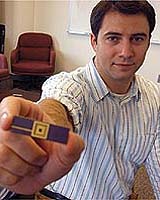
Rochester NY (SPX) Nov 10, 2006 Homeland Security and biomedical imaging could benefit from new detector technology A new generation of imaging detectors with low-noise and high-speed capabilities may transform imaging applications on NASA space missions, impact biomedical imaging and aid in homeland defense. Rochester Institute of Technology and the University of Rochester recently won $847,000 from NASA's Astronomy Physics Research and Analysis program to build and test a detector that will capture sharper images and consume less power than technology currently in use. The new imaging sensor, which will function at wavelengths spanning from ultraviolet to mid-infrared, will be able to operate reliably in the harsh radiation environment of space. "These benefits will lead to lower mission cost and greater scientific productivity," says Donald Figer, director of the Rochester Imaging Detector Laboratory at RIT and lead scientist on the project. The team also includes Zoran Ninkov from RIT and Zeljko Ignjatovic from the University of Rochester. The new detector is based on a technology created by Ignjatovic and his colleagues at the UR. It will shrink the required hardware on NASA planetary missions from the size of a crate weighing tens of pounds to a tiny thumb-sized chip. It also will enhance images captured by ground telescopes that will rival those from orbiting telescopes, like the Hubble Space Telescope. Ignjatovic's chip integrates an analog-to-digital converter at each pixel in a sensor. "Previous attempts to do this on-pixel conversion have required far too many transistors, leaving too little area to collect light," says Ignjatovic. "First tests on the chip show that it uses 50 times less power than the industry's current best, which is especially helpful on deep-space missions where energy is precious." Despite the chip's low power consumption and sensitivity, it is surprisingly resistant to the radiation noise of space. Since each pixel converts the signal from analog to digital before moving it off-chip, the signal is digital and clear before it has a chance to travel and degrade. Coatings applied to the light sensitive portion of the sensor will optimize the technology and the ability to detect a range of wavelengths. RIT's Ninkov will explore techniques for bonding the coating to the delicate circuit using industrial microwave ovens. Further testing of the overall system will determine how the sensors hold up in cryogenic environments where the device is cooled to very low temperatures, imitating conditions in space. In addition to astronomical applications, the detector could improve biomedical imaging devices used in emergency rooms or on battlefields. The technology could aid in homeland security surveillance efforts to watch the nation's borders. Likewise, military applications could adopt the detector for use as airborne or space-based lasers designed to shoot down missiles aimed at the United States. Figer was recruited by RIT's Chester F. Carlson Center for Imaging Science through a faculty development program grant awarded by the New York State Office of Science, Technology and Academic Research (NYSTAR). The grant provides interim state assistance to help attract distinguished faculty throughout the world to New York's academic research centers, and to retain leading researchers already in New York Institutions of Higher Education. "In the first year of the NYSTAR award, we're landing this anchor project for our program," Figer says. "With this project, we will establish the capability to develop imaging sensors for multidisciplinary applications, an important objective in becoming an internationally leading laboratory, and in leveraging cutting-edge technologies for the benefit of regional industry." Community Email This Article Comment On This Article Related Links Rochester Institute of Technology All about the technology of space and more Making money out of watching earth from space today Earth Observation News - Suppiliers, Technology and Application
 SSTL Signs Contract With Federal Republic Of Nigeria For Supply Of EO Satellite
 Guilford UK (SPX) Nov 07, 2006
British satellite specialists Surrey Satellite Technology (SSTL) has signed a contract in Abuja for the supply of the NIGERIASAT-2 Earth observation satellite, related ground infrastructure and a training programme to further develop an indigenous space capability in the Federal Republic of Nigeria. |
|
|

| The content herein, unless otherwise known to be public domain, are Copyright 1995-2006 - SpaceDaily.AFP and UPI Wire Stories are copyright Agence France-Presse and United Press International. ESA PortalReports are copyright European Space Agency. All NASA sourced material is public domain. Additionalcopyrights may apply in whole or part to other bona fide parties. Advertising does not imply endorsement,agreement or approval of any opinions, statements or information provided by SpaceDaily on any Web page published or hosted by SpaceDaily. Privacy Statement |