|
 |
 |
 |
 |
 |
 |
 |
 |

 |
Newfound Planetary System Has "Hometown" Look
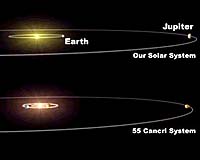
Pasadena - June 13, 2002 After 15 years of observation and a lot of patience, the world's premier planet-hunting team has finally found a planetary system that reminds them of our own home solar system. Dr. Geoffrey Marcy, astronomy professor at the University of California, Berkeley, and astronomer Dr. Paul Butler of the Carnegie Institution of Washington, Washington, D.C., today announced the discovery of a Jupiter-like planet orbiting a Sun- like star at nearly the same distance as the Jovian system orbits our Sun. "All other extrasolar planets discovered up to now orbit closer to the parent star, and most of them have had elongated, eccentric orbits. This new planet orbits as far from its star as our own Jupiter orbits the Sun," said Marcy. NASA and the National Science Foundation fund the planet-hunting team. The star, 55 Cancri in the constellation Cancer, was already known to have one planet, announced by Butler and Marcy in 1996. That planet is a gas giant slightly smaller than the mass of Jupiter and whips around the star in 14.6 days at a distance only one-tenth that from Earth to the Sun. Using as a yardstick the 93-million mile Earth-Sun distance, called an astronomical unit or AU, the newfound planet orbits at 5.5 AU, comparable to Jupiter's distance from our Sun of 5.2 AU (about 824 million kilometers or 512 million miles). Its slightly elongated orbit takes it around the star in about 13 years, comparable to Jupiter's orbital period of 11.86 years. It is 3.5 to 5 times the mass of Jupiter. "We haven't yet found an exact solar system analog, which would have a circular orbit and a mass closer to that of Jupiter. But this shows we are getting close, we are at the point of finding planets at distances greater than 4 AU from the host star," said Butler. "I think we will be finding more of them among the 1,200 stars we are now monitoring." The team shared its data with Dr. Greg Laughlin, assistant professor of astronomy and astrophysics at the University of California, Santa Cruz. His dynamical calculations show that an Earth-sized planet could survive in a stable orbit between the two gas giants. For the foreseeable future, existence of any such planet around 55 Cancri will remain speculative. "The existence of analogs to our solar system adds urgency to missions capable of detecting Earth-sized planets � first the Space Interferometry Mission and then the Terrestrial Planet Finder," said Dr. Charles Beichman, NASA's Origins Program chief scientist at the agency's Jet Propulsion Laboratory, Pasadena, Calif. "This planetary system will be the best candidate for direct pictures when the Terrestrial Planet Finder is launched later this decade," said UC Berkeley astronomer Dr. Debra A. Fischer. Marcy, Butler, Fischer and their team also announced a total of 13 new planets today, including the smallest ever detected: a planet circling the star HD49674 in the constellation Auriga at a distance of .05 AU, one-twentieth the distance from Earth to the Sun. Its mass is about 15 percent that of Jupiter and 40 times that of Earth. This brings the number of known planets outside our solar system to more than 90. Discovery of a second planet orbiting 55 Cancri culminates 15 years of observations with the 3-meter (118-inch) telescope at Lick Observatory, owned and operated by the University of California. The team also includes Dr. Steve Vogt, University of California, Santa Cruz; Dr. Greg Henry, Tennessee State University, Nashville; and Dr. Dimitri Pourbaix, the Institut d'Astronomie et d'Astrophysique, Universit� Libre de Bruxelles. The star 55 Cancri is 41 light years from Earth and is about 5-billion years old. Further data are needed to determine whether yet another planet is orbiting it, because the two known planets do not explain all the observed Doppler wobbling. One possible explanation is a Saturn-mass planet orbiting about .24 AU from the star. Community Email This Article Comment On This Article Related Links ExoPlanets Terrestrial Planet Finder SpaceDaily Search SpaceDaily Subscribe To SpaceDaily Express Life Beyond Earth Lands Beyond Beyond - extra solar planets - news and science
 Latching Onto Lichen
 Moffett Field CA (SPX) Dec 06, 2005
Bacteria can often survive the harsh conditions of space, and their toughness and adaptability have made them key candidates for the transfer of life between planets. But in a recent study by European scientists, lichen survived a trip in space even better than bacteria do. |
|
|

| The content herein, unless otherwise known to be public domain, are Copyright 1995-2006 - SpaceDaily.AFP and UPI Wire Stories are copyright Agence France-Presse and United Press International. ESA PortalReports are copyright European Space Agency. All NASA sourced material is public domain. Additionalcopyrights may apply in whole or part to other bona fide parties. Advertising does not imply endorsement,agreement or approval of any opinions, statements or information provided by SpaceDaily on any Web page published or hosted by SpaceDaily. Privacy Statement |