|
 |
 |
 |
 |
 |
 |
 |
 |

 |
New, More Accurate Measurements Of Earth's Water Distribution
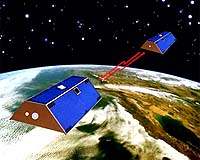
Austin TX (SPX) Aug 26, 2004 Engineers at The University of Texas at Austin have developed the capability for measuring large-scale changes in the Earth's water availability. The development, reported in the July 23 issue of Science, will make climate change studies much more accurate. The engineers used measurements of small changes in the Earth's gravitational field to provide the clearest picture yet of water's movement above and below the Earth's surface. Along with the changes over the globe, the Science paper describes month-to-month changes in Earth's gravity field over the Amazon basin, the largest watershed on the planet. As the basin becomes drier, the gravitational force decreases, demonstrating that water has a direct effect on Earth's gravitational field. "The water cycle is one of the more important mechanisms of the Earth's interactions. Measurements of surface water in large inaccessible river basins have been difficult to acquire and underground aquifers and deep ocean currents have previously remained difficult or impossible to measure," says Dr. Byron Tapley, professor of aerospace engineering at The University of Texas at Austin, director of the university's Center for Space Research and chief author of the paper. "Now these measurements can be added to other time varying signals, such as changes in the polar ice cap balance, to provide a more accurate, comprehensive picture of climate change." The sub-surface measurements resulted from the NASA/German Aerospace Agency mission called the Gravity Recovery and Climate Experiment (GRACE). GRACE's twin satellites have been orbiting the Earth for two years, producing monthly gravity maps that are up to 1,000 times more accurate than current maps. Because water variations introduce a change in mass, there will be a gravity signal associated with this change. The engineers plan to use this signal to map more precisely underground water sites, pressure variation at ocean floor depths and mean sea level variations. "GRACE's ability to penetrate the Earth's surface to monitor changes in underground reservoirs provides new and very important information for monitoring water availability and climate change," says Tapley, principal investigator for the GRACE mission. The researchers' Science paper discusses how they have studied the satellites' sequence of monthly maps, and verified GRACE's ability to monitor seasonal variations in continental hydrology. The gravity measurements will be used in tandem with current water models to sketch an accurate picture of real-time water locations worldwide. "We know that current hydrology models leave out important components of the water cycle that have been difficult or impossible to measure directly. By comparing these hydrology models to the results of GRACE, we hope to close the gap between the two, thereby learning something about water storage and water transport that has previously not been observed at this level," says Paul Thompson, a graduate research assistant at the center and the paper's co-author. The water cycle involves the sun heating the ocean, causing evaporation of water into the atmosphere. The atmospheric winds move the moisture to other parts of the Earth's surface where it falls as rain or snow. The rain and snow, after it melts, either enters underground reservoirs or runs off into the oceans closing the water cycle. The mass movement associated with these events has a readily observable signal, which GRACE can detect. Components such as rain, oceans, snow and ice, make up the planet's "water budget." By knowing information about some pieces of the water budget (gathered from sources other than GRACE) and knowing the total effect of all the pieces, engineers can now infer what the lesser known components are doing. They call it "closing the water budget." Other Center for Space Research authors of the paper include Dr. Srinivas Bettadpur and Dr. John C Ries. Community Email This Article Comment On This Article Related Links The University of Texas at Austin GRACE at UTexas SpaceDaily Search SpaceDaily Subscribe To SpaceDaily Express Water News - Science, Technology and Politics
 China To Improve Water Supply
 Beijing (XNA) Dec 18, 2005
Chinese Vice Premier Hui Liangyu said Saturday China will speed up construction of water supply projects, while giving priority to water conservancy for sustainable use of water resources in the coming year. |
|
|

| The content herein, unless otherwise known to be public domain, are Copyright 1995-2006 - SpaceDaily.AFP and UPI Wire Stories are copyright Agence France-Presse and United Press International. ESA PortalReports are copyright European Space Agency. All NASA sourced material is public domain. Additionalcopyrights may apply in whole or part to other bona fide parties. Advertising does not imply endorsement,agreement or approval of any opinions, statements or information provided by SpaceDaily on any Web page published or hosted by SpaceDaily. Privacy Statement |