|
 |
 |
 |
 |
 |
 |
 |
 |

 |
New Window Opens On The Secret Life Of Microbes
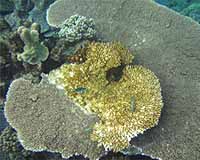
Washington DC (SPX) Mar 14, 2008 Nowhere is the principle of "strength in numbers" more apparent than in the collective power of microbes: despite their simplicity, these one-cell organisms--which number about 5 million trillion trillion strong (no, that is not a typo) on Earth--affect virtually every ecological process, from the decay of organic material to the production of oxygen. But even though microbes essentially rule the Earth, scientists have never before been able to conduct comprehensive studies of microbes and their interactions with one another in their natural habitats. Now, a new study--funded by the National Science Foundation (NSF) and described in the March 12, 2008 online issue of Nature--provides the first inventories of microbial capabilities in nine very different types of ecosystems, ranging from coral reefs to deep mines. "These new microbial inventories provide a new and important window into ecosystems and how they respond to stresses, such as pesticide runoff and invasive species," said Lita Proctor, an NSF program director. Rather than identifying the kinds of microbes that live in each ecosystem, the study catalogued each ecosystem's microbial "know-how," captured in its DNA, for conducting metabolic processes, such as respiration, photosynthesis and cell division. These microbial catalogues are more distinctive than the identities of resident microbes. "Now microbes can be studied by what they can do not who they are," said Proctor. This microbial study employed the principles of metagenomics, a powerful new method of analysis that characterizes the DNA content of entire communities of organisms rather than individual species. One of the main advantages of metagenomics is that it enables scientists to study microbes--most of which cannot be grown in the laboratory--in their natural habitats. Specifically, the microbial study produced the following results: - A unique, identifying microbial fingerprint for each of nine different types of ecosystems. Each ecosystem's fingerprint was based on its unique suite of microbial capabilities. - Methods for early detection of ecological responses to environmental stresses. Such methods are based on the principle that "microbes grow faster and so respond to environmental stresses more quickly than do other types of organisms," said Forest Rohwer of San Diego State University, a member of the research team. Because microbes are an ecosystem's first-responders, by monitoring changes in an ecosystem's microbial capabilities, scientists can detect ecological responses to stresses earlier than would otherwise be possible--even before such responses might be visibly apparent in plants or animals, Rohwer said. - Evidence that viruses--which are known to be ten times more abundant than even microbes--serve as gene banks for ecosystems. This evidence includes observations that viruses in the nine ecosystems carried large loads of DNA without using such DNA themselves. Rohwer believes that the viruses probably transfer such excess DNA to bacteria during infections, and thereby pass on "new genetic tricks" to their microbial hosts. The study also indicates that by transporting the DNA to new locations, viruses may serve as important agents in the evolution of microbes. Community Email This Article Comment On This Article Related Links National Science Foundation (NSF) Darwin Today At TerraDaily.com
 Arctic Climate Models Playing Key Role In Polar Bear Decision
 Madison WI (SPX) Mar 13, 2008
The pending federal decision about whether to protect the polar bear as a threatened species is as much about climate science as it is about climate change. The U.S. Fish and Wildlife Service (FWS) is currently considering a proposal to list the polar bear as a threatened species under the Endangered Species Act, a proposal largely based on anticipated habitat loss in a warming Arctic. |
|
|

| The content herein, unless otherwise known to be public domain, are Copyright 1995-2007 - SpaceDaily.AFP and UPI Wire Stories are copyright Agence France-Presse and United Press International. ESA Portal Reports are copyright European Space Agency. All NASA sourced material is public domain. Additional copyrights may apply in whole or part to other bona fide parties. Advertising does not imply endorsement,agreement or approval of any opinions, statements or information provided by SpaceDaily on any Web page published or hosted by SpaceDaily. Privacy Statement |