|
 |
 |
 |
 |
 |
 |
 |
 |

 |
New Wave Of Australian Ocean Robots
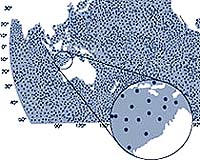
Sydney - Mar 18, 2002 Within the next four years, 3,000 free-floating ocean robots will be deployed in the oceans around the world, most of them in the Southern Hemisphere, as part of the next wave of climate alert systems. Oceanographers and climate scientists from CSIRO and the Bureau of Meteorology are leading the international pilot program in the region with 10 Argo floats deployed in 1999 to monitor the Indian Ocean between Australia and Indonesia. "Seeding the global ocean with 3,000 floats is the next logical step, following more than a decade of development and their successful deployment," says Stan Wilson, from the National Oceanic and Atmospheric Administration (NOAA) in the United States. Dr Wilson, NOAA's Director of International Ocean Programs, NOAA/OAR, works to help ensure the program is promoted within the international community and that the necessary financial resources are made available within the partner countries. "Argo brings the international community together as we better monitor and understand the climate system," says Dr Wilson, who is one of the oceanographers meeting in Hobart this week. The Argo program, in combination with a range of other ocean-observing systems including satellites, will soon provide information on ocean behaviour within hours of measurements being taken. Dr Dean Roemmich from Scripps Institute of Oceanography chairs the International Argo Science Team. Argo has grown from having funded 65 floats in 1999 to 225 in 2000 and 480 in 2001. More than 600 floats will be funded by 2002 by the 13-member participating countries and the European Commission. By the end of this year, funds will have been secured for more than a third of the global array. Today there are 337 operational floats throughout the world's oceans sending back real-time data about water temperature, salinity, and currents. The 1.5 metre autonomous floats ride the ocean currents and sink about 2000 metres into the water and drift for 10 days. As they rise to the surface, they collect data which are transmitted via satellite to ground stations. The data gets onto the Global Telecommunications System for use by the operational forecast agencies worldwide. The data is fully and openly available with no periods of exclusive use by anyone, representing a fundamental change in the way traditional oceanography has been done. Argo would not be possible without the "full and open" data policy. It allows use of data by agencies for operational forecasts (thus helping demonstrate the societal benefits), as well as the research community thus contributing to our understanding of the role of the oceans in climate. While the bulk of robotic floats are in the northern Hemisphere, ultimately two-thirds of all floats will be deployed south of the Equator and this week's meeting is expected to plan for those deployments. Dr Wilson says ocean data and research are essential to:
Meeting participants represent many of the countries engaged in the Argo program, including Canada, Korea, India, France, Germany, New Zealand, Japan, China, Russia, Indonesia, United States, Australia, and the United Kingdom. Discussions will center on technical issues as well as plans for future Argo deployment. The international Argo effort began in 1999 . The goal is to have 3,000 floats in the ocean by 2006. The Argo array is part of the Global Climate Observing System/Global Ocean Ocean Observing System (GCOS/GOOS) and contributes to both the Climate Variability and Predictability Experiment (CLIVAR) and the Global Ocean Data Assimilation Experiment (GODAE). Community Email This Article Comment On This Article Related Links Argo CSIRO Marine Research Robotic Floats SpaceDaily Search SpaceDaily Subscribe To SpaceDaily Express Dirt, rocks and all the stuff we stand on firmly
 Magnetic Reconnection Region Larger Than 2.5 Million Km Found In The Solar Wind
 Paris (ESA) Jan 12, 2006
Using the ESA Cluster spacecraft and the NASA Wind and ACE satellites, a team of American and European scientists have discovered the largest jets of particles created between the Earth and the Sun by magnetic reconnection. This result makes the cover of this week's issue of Nature. |
|
|

| The content herein, unless otherwise known to be public domain, are Copyright 1995-2006 - SpaceDaily.AFP and UPI Wire Stories are copyright Agence France-Presse and United Press International. ESA PortalReports are copyright European Space Agency. All NASA sourced material is public domain. Additionalcopyrights may apply in whole or part to other bona fide parties. Advertising does not imply endorsement,agreement or approval of any opinions, statements or information provided by SpaceDaily on any Web page published or hosted by SpaceDaily. Privacy Statement |