|
 |
 |
 |
 |
 |
 |
 |
 |

 |
New Technique That Improves The Power Of Atomic Force Microscopy
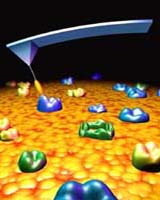
Tempe AZ (SPX) Aug 17, 2004 A team of researchers have developed a method that could vastly improve the ability of atomic force microscopes to "see" the chemical composition of a sample, follow variations of the sample, as well as map its topographic structure. The advance could have significant implications for drug development by allowing scientists to monitor the effects of potential drugs on an ever-smaller scale, according to Stuart Lindsay, director of the Center for Single Molecule Biophysics at the Biodesign Institute at Arizona State University and a lead researcher on the project. Lindsay, an ASU professor in the department of physics and astronomy said the new technique allows an atomic force microscope to "see," on a nanometer scale, the chemical composition of molecules. "Atomic force microscopy has a resolution down to an atomic level, but until now it has been blind to identifying specific chemical compositions," Lindsay said. The researchers - Lindsay, Hongda Wang, Ralph Bash, Brian Ashcroft, and Dennis Lohr of Arizona State University; Cordula Stroh, Hermann Gruber and Peter Hinterdorfer of the Institute of Biophysics at the University of Lintz, Austria; and Jeremy Nelson of Molecular Imaging Corporation, Tempe, Ariz. - present their findings in "Single Molecule Recognition Imaging Microscopy" in the current issue of the Proceedings of the National Academy of Sciences. The article is available on line. "If you imagine that all proteins are shaped like Lego blocks, then conventional atomic force microscopy (AFM) is feeling the Lego blocks on the floor, but it can't tell the difference between one block and another," Lindsay explained. "What we have done, is allow the person sitting on the floor and feeling those blocks to open their eyes and see that there are red Lego blocks, green Lego blocks and yellow Lego blocks." "This allows you to identify specific components in an image," he added. "It means you can now follow a complex process and see what's happening, at the molecular level, to one of the components. We are now giving AFM chemical sensitivity in much the way colored dyes gave optical microscopes optical sensitivity for much larger objects (~1 micron)." Atomic force microscopes provide images on the nanometer scale by using a highly sensitive and tiny probe that is essentially pulled across a surface. By doing this, researchers can obtain topographical images down to a nanometer scale. To use the AFM in its new mode, the researchers attached antibodies keyed to individual proteins to the tip of an AFM's probe. When an antibody reacts with the protein it is specifically targeted for, it creates a variance in the microscope's reading compared to a reading with a bare tip, thus showing the presence of a protein or other specific material in the region being scanned. To help ensure that the antibody tipped probe is truly sensitive, a strand of polymer connects the antibody to the tip, providing a tether that allows the antibody to wiggle into position to better connect with the protein receptors. A magnetically excited cantilever makes the tip oscillate up and down to make the antibody disconnect and reconnect and keep the probe moving. A key capability of this technique, Lindsay said, is that it allows researchers to see how components of a cell react on a molecular scale when they experience biological processes, such as their response to a specific chemical or compound. In this mode, it could provide researchers with a molecular "time-lapsed movie" of such reactions, which could lead to greater understanding of the chemical dynamics involved in how cells react to such stimuli. Lindsay said the new AFM method could be significant for drug discovery. "This development opens up the AFM as a research tool," Lindsay added. "The ability to identify the specific proteins on a membrane surface means you can take something very complex, like the surface of a human cell with all of the types of different receptors on it and ask questions about the local chemistry, like what is binding at those sites." "That will provide the fundamental knowledge you need to develop new drugs." Community Email This Article Comment On This Article Related Links The Biodesign Institute at ASU SpaceDaily Search SpaceDaily Subscribe To SpaceDaily Express Space Medicine Technology and Systems
 Genomic Sequences Processed In Minutes, Rather Than Weeks
 Richland WA (SPX) Jun 22, 2005
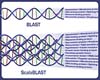
A new computational tool developed at the Department of Energy's Pacific Northwest National Laboratory is speeding up our understanding of the machinery of life - bringing us one step closer to curing diseases, finding safer ways to clean the environment and protecting the country against biological threats. |
|
|

| The content herein, unless otherwise known to be public domain, are Copyright 1995-2006 - SpaceDaily.AFP and UPI Wire Stories are copyright Agence France-Presse and United Press International. ESA PortalReports are copyright European Space Agency. All NASA sourced material is public domain. Additionalcopyrights may apply in whole or part to other bona fide parties. Advertising does not imply endorsement,agreement or approval of any opinions, statements or information provided by SpaceDaily on any Web page published or hosted by SpaceDaily. Privacy Statement |