|
 |
 |
 |
 |
 |
 |
 |
 |

 |
New Superconductor Study Confirms, Extends Nobel Theory
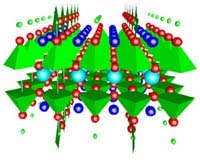
Washington - Nov 10, 2003 The behavior of intermetallic superconductors, like the kind used in hospital MRI machines, is even more curious than recent Nobel Prize-winning physicist Alexei Abrikosov had theorized. In newly reported research, scientists working at the National Institute of Standards and Technology (NIST) Center for Neutron Research have determined that so-called type II superconductors have the equivalent of a multiple personality---at least three distinct physical states, each with its own superconducting behavior. The result should help engineers design new materials for stronger, more efficient superconducting magnets. Nearly 50 years ago, Abrikosov predicted that superconductors could retain superconductivity in a very strong magnetic field by forming tiny eddies of current. These vortices allow the field to pass through without disrupting the current, until a certain threshold is reached and the resistance-free flow of electrons ceases. Just before the collapse, however, the materials undergo a dramatic spike in current, called the peak effect. Over a wide range of temperatures and magnetic field strengths, Brown University and NIST scientists tracked the movements of current eddies in a prototype type II superconductor, niobium. Their experiments yielded a phase diagram, a kind of a map that shows how current vortices rearrange in response to changes in temperature and magnetic field. The study confirmed an earlier set of the team's findings, but also revealed richer, more complex behavior. The recent work verified that the peak-effect jump in current corresponds to an abrupt change in the vortex arrangement--similar to the transformation that occurs when ice melts. They also provide the first experimental confirmation of Abrikosov's prediction that a smooth phase transition occurs for conditions that don't produce the peak effect. Community Email This Article Comment On This Article Related Links National Institute of Standards and Technology SpaceDaily Search SpaceDaily Subscribe To SpaceDaily Express Space Technology News - Applications and Research
 Industry Team Achieve New Communications Technology With AESA Radars
 Baltimore MD (SPX) Jan 12, 2006
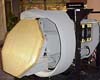
A team comprised of three leading US aerospace and defense contractors has demonstrated an innovative technological use of active electronically scanned array (AESA) radars for high-bandwidth communications. |
|
|

| The content herein, unless otherwise known to be public domain, are Copyright 1995-2006 - SpaceDaily.AFP and UPI Wire Stories are copyright Agence France-Presse and United Press International. ESA PortalReports are copyright European Space Agency. All NASA sourced material is public domain. Additionalcopyrights may apply in whole or part to other bona fide parties. Advertising does not imply endorsement,agreement or approval of any opinions, statements or information provided by SpaceDaily on any Web page published or hosted by SpaceDaily. Privacy Statement |