|
 |
 |
 |
 |
 |
 |
 |
 |

 |
New Study In Moths Shows Insects Not Entirely Ruled By Instinct
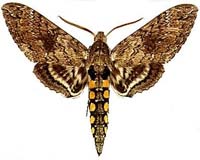
Columbus OH (SPX) Jul 13, 2004 By examining the brain activity of moths, researchers have found that the behavior of these insects isn't ruled entirely by instinct. Rather, they can learn which odors mean food. The findings are more than academic: The researchers hope to develop methods for using trained moths to detect odors of interest for defense industry and law enforcement � such as odors given off by biological and chemical weapons. Animal behaviorists have historically argued that most insects have a programmed response to a variety of situations, such as knowing which odors signal the presence of food and mates. But scientists are discovering that animals don't always instinctively know what to do. In these cases, they have to learn, said Kevin Daly, the study's lead author and a research scientist in entomology at Ohio State University. He and his colleagues used tiny electrodes implanted in the heads of sphinx moths to continuously monitor the insect's neuronal activity and feeding behavior before, during and after training the animal that one odor meant food � sugar water � was on the way and another odor did not. "We saw a dramatic restructuring of the neural networks that convert scent into a code that the rest of the brain can understand," Daly said. "The changes in this coding suggest that the moths learned to differentiate between an odor that meant food and an odor that didn't." Understanding how moths detect and discriminate between scents could have wide-reaching applications. In related work, Daly and his colleagues are training moths and bees to detect odors from manufactured explosives. "In principle, if we can understand how insects learn and distinguish between odors, we could 'train' these animals to recognize any detectable odor of interest," he said. The findings currently appear online in the Proceedings of the National Academy of Sciences. The electrodes placed in the moths' brains registered the activity of neurons. Electrodes were also placed on feeding muscles to monitor the activity of the proboscis � a long tube that a moth uses for feeding � when the insects were exposed to different odors and to sugar. The researchers wanted to see how a moth's nervous system changed its response to an odor that was associated with food and how the moth responded behaviorally to that odor. The moths were restrained in plastic tubes, leaving the antennae and proboscis accessible. Electrodes were inserted into each insect's head; Daly said that brain recordings could be made for up to 48 hours in these conditions. These moths normally live for a few days as adults. The investigators put the bound moths through different odor conditioning trials: one created a clear relationship between an odor and food. In this case, the researchers wanted to see what happened in the brain and proboscis before, during and after the moths were exposed to the food-associated odor. In the second trial, moths were exposed to two odors, but only one predicted food. Both trials exposed moths to a series of 20 millisecond-long puffs of odor. When odor predicted food, the researchers saw a significant and progressive increase � by about 60 percent � in the number of neurons responding to the odor. This increase in the neural network response indicated that the moths learned to associate the odor with food. The researchers also saw striking differences in neuronal activity between the odor that predicted food and the odor that had nothing to do with food. "More neurons were recruited into action when a moth smelled the odor connected to food," Daly said. "After a few exposures to this odor, moths automatically started sucking for the food, even when they weren't rewarded with food. They also learned to not respond to the odor that was unrelated to food. "After learning, the way their nervous system responded to odor changed," he said. Now that he and his colleagues have documented these nervous system changes, their next step is to take a deeper look into the neural networks and figure out what causes them to respond to changes. "This study is a first pass at trying to understand how sensory neural networks code information, and how that coding process changes as an animal gains experience," Daly said. "Ultimately, if we really want to understand how an animal changes its behavior, we have to go into the brain," he continued. Daly conducted the research with Brian Smith, a professor of entomology at Ohio State, and in collaboration with Thomas Christensen, Hong Lei and John Hildebrand, all with the University of Arizona in Tucson. The National Institutes of Health and the Defense Advanced Research Projects Agency funded this study. Community Email This Article Comment On This Article Related Links Ohio State University University of Arizona, Tucson SpaceDaily Search SpaceDaily Subscribe To SpaceDaily Express Dirt, rocks and all the stuff we stand on firmly
 Magnetic Reconnection Region Larger Than 2.5 Million Km Found In The Solar Wind
 Paris (ESA) Jan 12, 2006
Using the ESA Cluster spacecraft and the NASA Wind and ACE satellites, a team of American and European scientists have discovered the largest jets of particles created between the Earth and the Sun by magnetic reconnection. This result makes the cover of this week's issue of Nature. |
|
|

| The content herein, unless otherwise known to be public domain, are Copyright 1995-2006 - SpaceDaily.AFP and UPI Wire Stories are copyright Agence France-Presse and United Press International. ESA PortalReports are copyright European Space Agency. All NASA sourced material is public domain. Additionalcopyrights may apply in whole or part to other bona fide parties. Advertising does not imply endorsement,agreement or approval of any opinions, statements or information provided by SpaceDaily on any Web page published or hosted by SpaceDaily. Privacy Statement |