|
 |
 |
 |
 |
 |
 |
 |
 |

 |
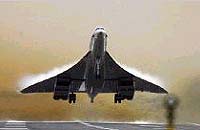
New Research Could Lead To Less Noise For Airplane Takeoffs, Landings
Huntsville AL (SPX) Sep 09, 2004 Airplanes fly over Kader Frendi's home in Madison frequently, and the roaring of the craft's approach to the airport serves as a reminder of research he is conducting at The University of Alabama in Huntsville. Frendi is searching for ways to reduce noise associated with the takeoff and landing of aircraft. He has been investigating the science of noise generation and noise reduction during most of his academic career. He joined UAH's mechanical and aerospace engineering department five years ago, and is spending most of his time today conducting research in computational fluid dynamics and building the university's capabilities in computing power. Computational fluid dynamics (CFD) uses computers to solve complex nonlinear partial differential equations that model a problem of external or internal airflow over vehicle shapes. In practice, a physical object and the space surrounding that object are represented by a large number of grid points, and in the case of his airplane research as many as 40 million points will be used on a small section of the wing. "One of the big concerns in the aeronautical field is the noise level generated by the takeoff and landing approaches of airplanes," he said. "Most people don't know it, but during these two flight regimes (i.e. takeoff and landing) the noise from the airframe is almost equal to the noise made by the airplane's propulsion system." Most of the noise during the plane's approach to the runway is generated by the landing gear, the wing and the moving parts of the wing. Frendi has received a three-year, $200,000 grant from NASA-Langley to understand the source of those noises and to find ways to better control them. The process of gaining that understanding starts by creating a grid with millions of points to represent a physical object and the space surrounding the object. In this case, Frendi is computing the flow over a section of an airplane wing using approximately 40 million points. However, a limiting issue in CFD research is computing power. The computations get pretty complex very quickly when at each grid point you need to compute five variables (sometimes more). In addition, the computation needs to be carried out for a certain length of time to get all of the flow statistics. This complication arises because of the turbulent nature of the flow around such objects. Such research in the past would take months or years. Today, Frendi will get the results within one week. These advances have been helped by more powerful computers, but even today's fast PCs still lack the power necessary for CFD research. So, Frendi is using the concept of cluster computing to solve that problem. He has created the CFD Laboratory at UAH by linking 64 computers together. "This 64-node cluster will allow us to find the noise sources and analyze the data much more quickly," he said. One of the challenges in cluster computing is dividing the computations among the various machines. Each of the 64 machines will handle anywhere from 500,000 to 1 million points apiece. "We will have to balance the load among the machines," Frendi said. "If one node doesn't have an equitable share, then it slows that one computer down. If you slow down one computer, you slow down all 64." That leads to another challenge of cluster computing � communication among the machines. But that has been solved with a new Ethernet connection that is capable of transmitting data at 1 gigabyte per second. "We have moved beyond many obstacles in CFD research today," Frendi said. "When I was at Langley (NASA research center) 10 years ago, we couldn't compute 1 million grid points. Today, we are using 40 million grid points. That's still too small." CFD researchers are ambitious, he said, and the science will continue to evolve rapidly. As a matter of fact, Frendi was quick to point out that even though the university just opened the 64-node lab, he is already looking at expanding UAH's CFD Lab and doubling its capacity to 128 computers. "We've designed the lab with growth in mind. CFD research has a lot of applications, and the best way to take advantage of those opportunities is to build the university's CFD capabilities." Community Email This Article Comment On This Article Related Links University of Alabama Aerospace at NASA SpaceDaily Search SpaceDaily Subscribe To SpaceDaily Express Space Tourism, Space Transport and Space Exploration News
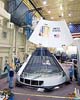
 NASA Refines Design For Crew Exploration Vehicle
 Washington DC (SPX) Jan 12, 2006
NASA's Constellation Program is making progress toward selecting a prime contractor to design, develop and build the Crew Exploration Vehicle (CEV), America's first new human spacecraft in 30 years. |
|
|

| The content herein, unless otherwise known to be public domain, are Copyright 1995-2006 - SpaceDaily.AFP and UPI Wire Stories are copyright Agence France-Presse and United Press International. ESA PortalReports are copyright European Space Agency. All NASA sourced material is public domain. Additionalcopyrights may apply in whole or part to other bona fide parties. Advertising does not imply endorsement,agreement or approval of any opinions, statements or information provided by SpaceDaily on any Web page published or hosted by SpaceDaily. Privacy Statement |