|
 |
 |
 |
 |
 |
 |
 |
 |

 |
New Radar Flies High As Crucial Tests Begin
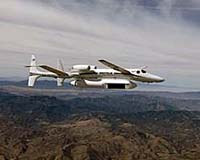
Hanscom AFB MA (AFNS) Oct 10, 2006 The path to greatly enhanced intelligence, surveillance and reconnaissance capability became clearer Sept. 30 with the first developmental test flight of a new, state-of-the-art radar system. The test, the first in what will be a year-long effort, was run by the 851st Electronic Systems Group, here, and its contractor team of Northrop Grumman and Raytheon. The radar system being tested is the Global Hawk variant of its Multi-Platform Radar Technology Insertion Program, often referred to simply as MP-RTIP. The team is conducting the tests aboard a Proteus, a manned, twin-turbofan, high-altitude, multi-mission aircraft about the same size as a Global Hawk. The aircraft, operating out of a commercial air field in Southern California, flew for nearly two hours, according Lt. Col. Pete Krawczyk, commander of the 638th Electronic Systems Squadron. During that time, the aircraft climbed to 22,000 feet and orbited at that altitude while radar system checks were conducted. The team was able to begin testing different radar modes, as well as various hardware components and communication links, Krawczyk said. The radar is controlled from the ground using a modified version of the Multi-Platform Common Data Link, which also allows real-time monitoring of performance. The MP-RTIP will provide advanced surveillance capabilities, including ground moving target indication, which tracks vehicle movement, and synthetic aperture radar, which returns high-resolution still images. In its larger configuration, the radar is also capable of providing precision air-to-air tracking and cruise missile defense. The larger version of the radar, referred to as the Wide Area Surveillance (WAS) sensor, is also being developed for the E-10A technology demonstration program. The E-10A demonstration will include incorporation of the radar onto a wide-body manned aircraft. NATO is also looking to incorporate this next-generation radar technology onto manned and unplanned platforms, Krawczyk said. NATO is considering a version of the Block 40 Global Hawk, on which the U.S. plans to install the radar for its unmanned requirement. The Proteus testing, which is three months ahead of the program's baseline schedule, will go a long way toward reducing risk, said Col. Dwyer Dennis, the 851st Group commander. In fact, one of the most impressive things about the testing program is that it's ahead of schedule despite its heavy emphasis on addressing integration issues as they're detected, he said. "This is all about executing the risk management plan," Dennis said. "If we see a risk, we don't move until we address it." The Proteus testing will benefit the WAS program, too. "Because they share common sensing modes, flying the Global Hawk MP-RTIP sensor translates to risk reduction for the wide-area surveillance sensor program," he added. The nearly 30-foot long, 3,000-pound pod carrying the radar also houses a number of critical auxiliary components. Among them: a dedicated power source for the radar, a data storage system to capture engineering data for later analysis, and a liquid cooling system. To ensure this heavy payload could be supported by Proteus, the team preceded the radar flight testing by flying a pod that simulated the real thing this past spring. The year-long testing program launched Saturday will proceed with weekly flight tests, the intensity and complexity of which will increase over time, said Scott Hardiman, the group's deputy director. A second, even-more capable radar unit is still undergoing testing in the Systems Integration Lab in El Segundo, Calif., he said. About half way through the testing program, this second radar unit will be substituted for the current one, allowing more sophisticated testing to occur. "This has been and will continue to be a very methodical process, like any good developmental test program, where we'll keep building as we go along," he said. "We'll also continue to be very diligent about dealing with any problems as they arise." While the Proteus testing is developmental, not operational, the Air Force Operational Test and Evaluation Center is observing the activity here, Hardiman said. The Proteus testing will be followed by data evaluation and then integration onto a Global Hawk Block 40 aircraft for continued testing, both developmental and operational. The first MP-RTIP-equipped Global Hawk is expected to be fielded in the 2011 timeframe, according to Global Hawk program managers. "The end result will be great new capability for the warfighter," Dennis said. Community Email This Article Comment On This Article Related Links 851st Electronic Systems Group The latest in Military Technology for the 21st century at SpaceWar.com The latest in Military Technology for the 21st century at SpaceWar.com
 Raytheon Delivers First Excalibur Production Rounds To The US Army
 Tucson AZ (SPX) Oct 10, 2006
The Raytheon Missile Systems and BAE Systems Bofors' Excalibur team delivered the first production Excalibur global positioning system-guided 155 mm artillery rounds to the U.S. Army Sept. 19, paving the way for the next series of testing required to field the weapon in theater early next year. Final assembly of the projectiles occurred at the McAlester Army Ammunition Plant in McAlester, Okla. |
|
|

| The content herein, unless otherwise known to be public domain, are Copyright 1995-2006 - SpaceDaily.AFP and UPI Wire Stories are copyright Agence France-Presse and United Press International. ESA PortalReports are copyright European Space Agency. All NASA sourced material is public domain. Additionalcopyrights may apply in whole or part to other bona fide parties. Advertising does not imply endorsement,agreement or approval of any opinions, statements or information provided by SpaceDaily on any Web page published or hosted by SpaceDaily. Privacy Statement |