|
 |
 |
 |
 |
 |
 |
 |
 |

 |
New Procedures To Retire GPS Birds To Reduce Collision Danger
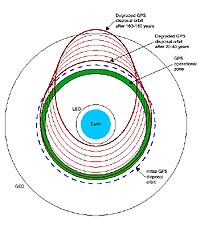
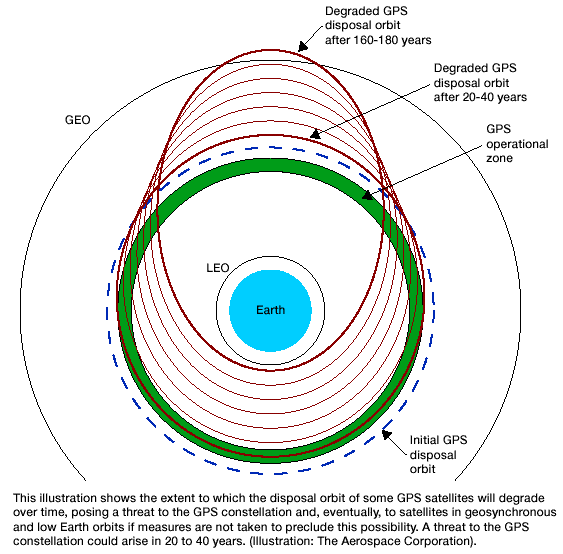
San Diego - March 7, 2002 By following revised procedures in disposing of decommissioned GPS satellites the possibility of collisions between these and operating satellites can be greatly reduced, researchers at The Aerospace Corporation have concluded. In studies for the Air Force, researcher Dr. Chia-Chun (George) Chao discovered that GPS satellites placed in disposal orbits can eventually, perhaps in 20 to 40 years, encroach into the operating constellation. This is because the disposal orbits, while circular initially, degenerate into orbits with significant eccentricity, or ovularity, mostly as the result of sun-moon gravitational perturbations. Besides intersecting the GPS constellation, these satellites eventually could pose a threat to operational satellites in low Earth and geosynchronous orbits, Dr. Chao said. The GPS constellation, comprising 28 satellites, operates at medium Earth orbit, about 11,000 miles above Earth. The solution, Aerospace studies show, is to
EELV, Glonass and Galileo Future GPS satellites�beginning with Block IIF in 2005�will be launched on the Evolved Expendable Launch Vehicle, or EELV, which, unlike current GPS launch vehicles, may leave an upper stage near the GPS constellation. An Air Force-sponsored study, with participation by Aerospace, is underway to develop a disposal procedure for these upper stages that will account for eccentricity growth. The Russian Glonass constellation, a navigation system similar to GPS, will also experience orbit eccentricity growth and may pose a collision risk to itself and GPS. A similar issue applies to Galileo, the planned European navigation constellation, Dr. Chao said. Glonass, which has about 100 failed satellites within its constellation, is located about 1,000 kilometers (621 miles) lower than GPS and could pose a collision problem in 40 years, the studies show. No solution to the Glonass problem has been advanced. Galileo which would be located about 2,000 or 3,000 kilometers (1,240 or 1,860 miles) above GPS, could pose a problem under current disposition plans, Dr. Chao said. However, he added, the Europeans are investigating a solution. Background Study of the GPS problem was funded by the Space and Missile Systems Center at Los Angeles Air Force Base, which also sponsored examinations�along with The Aerospace Corporation's Center for Orbital and Reentry Debris Studies�of the stability of disposal orbits for satellites in geosynchronous and low Earth orbits. The studies were undertaken to ensure compliance with U.S. government space debris mitigation guidelines. Findings in the geosynchronous study, performed by Dr. Chao, were used by the international Inter-Agency Space Debris Coordination Committee in the formulation of its recommended debris mitigation practices. The GPS study, written by Dr. Chao and first published by The Aerospace Corporation as a technical report, was presented at the January 2000 Space Flight Mechanics Meeting held by the American Astronautical Society and American Institute of Aeronautics and Astronautics in Clearwater, Florida. A follow-up study by Dr. Chao and Dr. Anne Gick, also of Aerospace, was presented at the February 2001 Space Flight Mechanics Meeting held in Santa Barbara, California. In addition, an associated study, "Analysis of the Collision Risk Associated With GPS Disposal Orbit Instability," was prepared by Alan Jenkin and Dr. Gick. All three researchers are with the company's Astrodynamics Department. The results of their work have been presented at international conferences as well as at the U.S. conferences. Community Email This Article Comment On This Article Related Links The Aerospace Corporation SpaceDaily Search SpaceDaily Subscribe To SpaceDaily Express Space Technology News - Applications and Research
 Industry Team Achieve New Communications Technology With AESA Radars
 Baltimore MD (SPX) Jan 12, 2006
A team comprised of three leading US aerospace and defense contractors has demonstrated an innovative technological use of active electronically scanned array (AESA) radars for high-bandwidth communications. |
|
|

| The content herein, unless otherwise known to be public domain, are Copyright 1995-2006 - SpaceDaily.AFP and UPI Wire Stories are copyright Agence France-Presse and United Press International. ESA PortalReports are copyright European Space Agency. All NASA sourced material is public domain. Additionalcopyrights may apply in whole or part to other bona fide parties. Advertising does not imply endorsement,agreement or approval of any opinions, statements or information provided by SpaceDaily on any Web page published or hosted by SpaceDaily. Privacy Statement |