|
 |
 |
 |
 |
 |
 |
 |
 |

 |
New Ozone Mini-Hole Over Europe
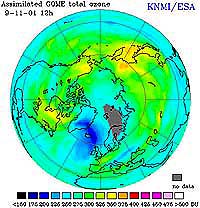
Paris - Nov, 12 2001 Scientists at The Netherlands' KNMI in cooperation with ESA are tracking an ozone mini hole opening over the North Atlantic and heading for Europe. The KNMI scientists predict that the mini hole will see ozone levels fall to 60-70% of the seasonal average as it sweeps from Greenland to southern Scandinavia over the next few days. KNMI's unique GOME Fast Delivery Service, developed under the ESA Data User Programme, harnesses near real time processing of data from the GOME instrument aboard ERS-2. The scientists are able to monitor the loss of ozone in the atmosphere, and watch the mini hole as it moves and deepens hour by hour, in real time. Ozone helps to shield the Earth's surface -- and skiers or sunbathers -- from the harmful ultraviolet light rays of the sun. This mini ozone hole does not present a significant threat, though. According to Ankie Piters at KNMI, "At this time of the year at our latitudes, the sun does not rise high enough above the horizon to deliver a significant amount of harmful ultra-violet light, but low ozone events over Europe are still of great interest. They seem to be caused mainly by unusual air currents in the atmosphere, not by chemical breakdown of ozone, which is what you see in the development of the Antarctic ozone hole." The significance of this event is that the measurements of the GOME instrument processed in near real-time enable detailed monitoring and analysis of this phenomenon. For the first time scientists are able to forecast such an event. "GOME is a spectrometer which scans the atmosphere below the flight path of the ERS-2 satellite," explains ESA's Claus Zehner. GOME gathers sunlight backscattered by the atmosphere and reflected by the earth's surface and analyses its spectrum from ultra-violet to infra-red. Different chemical "species" absorb specific wavelengths of light, so their presence shows up as absorption lines in the measured GOME spectra. Europe is already preparing the next generation of satellite instruments to improve the monitoring of ozone and other key chemicals in the atmosphere. The SCIAMACHY (SCanning Imaging Absorption spectroMeter for Atmospheric CartograpHY) instrument onboard ESA's environmental satellite Envisat will continue the GOME series of ozone measurements soon. Meanwhile, ESA and the European Organisation for the Exploitation of Meteorological Satellites, EUMETSAT, are preparing a series of three satellites (Metop) which will carry follow-on GOME instruments and will guarantee at least ten years continued monitoring of ozone from space from 2003 onwards. Community Email This Article Comment On This Article Related Links GOME homepage KNMI GOME at DLR ERS homepage Earthnet SpaceDaily Search SpaceDaily Subscribe To SpaceDaily Express Dirt, rocks and all the stuff we stand on firmly
 Environmental Damage Threatens Human Health
 Bangkok (AFP) Dec 9, 2005
Environmental damage threatens human health and may have contributed to the spread of new diseases like bird flu and SARS, the World Health Organization said in a report Friday. |
|
|

|
|
|
|
|
|
|
|
|
|
|
|
| The content herein, unless otherwise known to be public domain, are Copyright 1995-2006 - SpaceDaily.AFP and UPI Wire Stories are copyright Agence France-Presse and United Press International. ESA PortalReports are copyright European Space Agency. All NASA sourced material is public domain. Additionalcopyrights may apply in whole or part to other bona fide parties. Advertising does not imply endorsement,agreement or approval of any opinions, statements or information provided by SpaceDaily on any Web page published or hosted by SpaceDaily. Privacy Statement |