|
 |
 |
 |
 |
 |
 |
 |
 |

 |
New Orleans Plunged Into A Nightmare By Hurricane Katrina
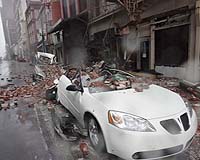
New Orleans (SPX) Aug 31, 2005 Hurricane-battered New Orleans, the jazz city known as "The Big Easy," was plunged into a nightmare on Tuesday, cut off from the outside world, submerged by rising floodwaters and troubled by signs of fraying public order. "We probably have 80 percent of our city under water," Mayor Ray Nagin said after breaches in levees protecting the low-lying Louisiana city sent floodwaters seeping into the streets. "It's almost like a nightmare that I hope we wake up from," Nagin told local WWL-TV. "Our city is in a state of devastation." Hundreds of looters ransacked shops on the edge of the storied French Quarter and elsewhere as authorities searched for ways to stop floodwaters spawned by deadly Hurricane Katrina from further swamping the city. New Orleans, most of which is below sea level, is surrounded on three sides by bodies of water, with Lake Pontchartrain in the north, Lake Borgne in the east and the Mississippi River in the south. Most of the flooding was being caused by a breach in the levee holding back Lake Pontchartrain, officials said, and US military engineers were searching for ways to plug the hole, including dropping shipping containers filled with sand from airplanes. "The breach in the 17th Street canal is about 200 feet (60 meters) wide," New Orleans Police Lieutenant Julie Wilson told WWL-TV. "The water is going to keep coming in until it reaches the level of the lake. I don't know what they are going to do." Fleeing flooded areas, hundreds of soaking wet, tired and thirsty people, some carrying babies, crossed the St. Claude drawbridge hoping to make their way to the massive Superdome stadium, which has been turned into an emergency shelter. Many crossing the bridge walked barefoot, having lost their shoes in the floodwaters. Some were able to bring a few possessions with them. Scores had dogs and cats, and one woman even brought her rabbit. "The devastation is greater than our worst fears," said Louisiana state Governor Kathleen Blanco. "It is just totally overwhelming. It is a tragedy of great proportions." "There's no electricity and won't be any for quite a while," the governor told reporters in Baton Rouge, the Louisiana capital. "There's no water. And there's no food to be had. "The communications network is completely gone," Blanco said. "We think there may be only one major way into the city right now." Rescue helicopters swooped on residential areas to snatch survivors from roofs lapped by water seeping into the city of 1.4 million people. With live power lines, gas pipes and debris including submerged cars floating below the surface of foul waters it was too dangerous for rescue workers to use boats in some areas, meaning Coast Guard and military helicopters bore the brunt of the rescue effort. Governor Blanco said rescuers have saved hundreds of people, but "many lives" have been lost. "We know that many lives have been lost," she said, but there was no way for authorities to put together any kind of reliable death or casualty toll. There were instances of looting in several areas of the city. Looters were seen on downtown Canal Street and in other areas, including overnight in the particularly hard-hit St. Bernard Parish neighborhood of the city. The authorities have imposed martial law in at least two parishes in New Orleans in a bid to deter looters, a day after Katrina swept ashore. Telephone communications with New Orleans were cut off and around 700,000 people were without power. The Superdome, which is holding at least 10,000 evacuees, was surrounded by water on Tuesday. Evacuees sat tight in the massive sports arena, which itself bore Katrina's scars after having much of its outer dome ripped off on Monday. "There's water lapping at the foot of the Superdome now," Blanco said. "I think I saw people walking in at about knee-deep. "The conditions there are very difficult," she said. "In the next phase, we'll be looking for places to evacuate the rest of the folks who found themselves at the Superdome."
earlier related report "The devastation is greater than our worst fears," said Louisiana state Governor Kathleen Blanco. "It is just totally overwhelming." The magnitude of the storm's destructive power was felt in equal measure along the shoreline of neighbouring Mississippi, where glitzy casinos, plush homes and shrimp fishing businesses lay in ruins, after a storm surge up to 30 feet (10 metres) high crashed ashore on Monday. "You're going to be looking at hundreds dead along the coast of Mississippi," said Vincent Creel, a spokesman for the devastated resort city of Biloxi. Rescuers in boats and helicopters struggled to reach hundreds of survivors stranded on rooftops, their efforts hampered by live power lines, broken gas pipes and debris including submerged cars floating below the surface of the rising waters. The flood situation was particularly critical in low-lying New Orleans, where a breach in the local network of protective canals and levees sent fresh floodwaters surging into the city, which authorities said was already 80 percent submerged. Governor Blanco said around 700 people had been brought to dry ground during the night, but warned that the absence of reliable casualty figures and reports of bodies floating in the water suggested the final human cost had yet to be counted. "We know that many lives have been lost," she said. Telephone communications with New Orleans were largely cut off and around 700,000 people were without power. Some victims had been stuck on the roofs of their homes for nearly 24 hours awaiting rescue. Officials warned of large numbers of gas leaks throughout the city and fires could be seen burning out of control in several areas. Parts of the famed French Quarter visited by an AFP correspondent which were dry on Monday were under as much as three feet (one meter) of water on Tuesday. Television footage showed the Louisiana Superdome, which is holding at least 10,000 evacuees, surrounded by water. Evacuees sat tight in the massive sports arena, which itself bore Katrina's scars after having much of its outer dome ripped off on Monday. There were instances of looting in several areas of New Orleans and the authorities imposed martial law in at least two parishes in a bid to maintain law and order. "Our city is in a state of devastation," Mayor Ray Nagin told WWL-TV. "With some sections of our city, the water is as deep as 20 feet (seven metres). It's almost like a nightmare that I hope we wake up from." More than a million people were without power across Mississippi, Louisiana and Alabama, water supplies were compromised and collapsed communications left large areas cut off from the outside world. Damage estimates soared into the billions of dollars and oil prices raced to the historic level of 70.85 dollars per barrel on anxiety over the damage to US production facilities. "This is our tsunami," said A.J. Holloway, mayor of Biloxi, where a tidal surge swept away bridges, sent boats crashing into buildings and flooded entire neighborhoods. Residents who ignored evacuation calls and chose to ride out the storm at home, emerged Tuesday from houses that looked more like demolition sites. "We lost the entire house," said Donnee Jones, the living room of her Biloxi seaside home invaded by 2.5 meters (eight feet) of debris, the kitchen completely missing, the walls half-collapsed, and four strange boats in the garden. Authorities said at least 50 people were known to have been killed in Biloxi alone, around 30 of them in a single apartment complex demolished by the storm. As the scale of the disaster became clear, the White House said President George W. Bush would lop the last two days off his vacation and head back to Washington on Wednesday to coordinate relief efforts. "The federal, state and local governments are working side by side to do all we can to help people get back on their feet," Bush said at a naval base in San Diego, California. "And we have got a lot of work to do." Community Email This Article Comment On This Article Related Links SpaceDaily Search SpaceDaily Subscribe To SpaceDaily Express Bringing Order To A World Of Disasters When the Earth Quakes A world of storm and tempest
 New Orleans Colleges To Reopen This Week
 New Orleans, Louisiana (AFP) Jan 05, 2006
Thousands of students and faculty are returning to New Orleans' eight colleges and universities this week for the first time since hurricane Katrina flooded the city four months ago. |
|
|

| The content herein, unless otherwise known to be public domain, are Copyright 1995-2006 - SpaceDaily.AFP and UPI Wire Stories are copyright Agence France-Presse and United Press International. ESA PortalReports are copyright European Space Agency. All NASA sourced material is public domain. Additionalcopyrights may apply in whole or part to other bona fide parties. Advertising does not imply endorsement,agreement or approval of any opinions, statements or information provided by SpaceDaily on any Web page published or hosted by SpaceDaily. Privacy Statement |