|
 |
 |
 |
 |
 |
 |
 |
 |

 |
New NOAA Research Vessel Completes Maiden Voyage
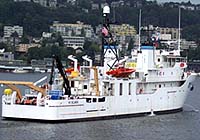
Honolulu HI (SPX) Oct 18, 2004 The newly commissioned National Oceanic and Atmospheric Administration research vessel Hi'ialakai has completed its first mission with a successful, comprehensive, five-week survey of marine ecosystems in the waters of the remote Northwestern Hawaiian Islands Coral Reef Ecosystem Reserve (NWHICRER). NOAA is an agency of the U.S. Department of Commerce. Homeported in Hawai'i to support coral reef ecosystem mapping and habitat activities in the greater Pacific under NOAA's National Ocean Service, Hi'ialakai was commissioned into the NOAA fleet on Sept. 3, 2004. The research cruise, which began Sept. 13, was Hi'ialakai's maiden voyage. This was a collaborative, multi-agency venture involving NOAA's National Ocean Service, National Marine Sanctuary Program, Northwestern Hawaiian Islands Coral Reef Ecosystem Reserve, NOAA Fisheries, Bishop Museum, the State of Hawai'i and the University of Hawai'i. "When we sailed Sept. 13 on our first mission, we carried the thought that the entire trip could be a shakedown cruise," said CDR Scott Kuester, NOAA, Hi'ialakai's commanding officer. "We found, however, that after the first few days, we were already operating full tilt, and the capabilities of the ship, its small boats, and especially the crew, have far exceeded the scientists' expectations. This bodes well for future projects." Kuester is an officer in the NOAA Corps, one of the nation's seven uniformed services. NOAA Corps officers operate and manage ships and aircraft in the NOAA research fleet. "I salute the officers, crew, and scientists on the safe return of NOAA Ship Hi'ialakai. She has faithfully carried out her mission of science and research to support our shared responsibility of managing the resources of the Northwestern Hawaiian Islands," said Sen. Daniel K. Inouye of Hawai'i. "I look forward to working with NOAA to build her the home at the new NOAA Pacific Regional Facility that she and her sister vessels deserve." During the 35-day cruise, 18 researchers conducted assessments, monitoring and mapping operations throughout the waters and reefs within the reserve as well as in adjacent waters managed by the State of Hawai'i and U.S. Fish and Wildlife Service. Researchers collected data on the abundance and diversity of fishes, algae, corals and other invertebrates on these reefs, while remote tethered camera arrays recorded habitat types in deeper waters. Coral biologists documented the present condition of some of these reefs since a major coral bleaching event was first detected in 2002. They also monitored a syndrome afflicting coral reefs in the French Frigate Shoals detected by researchers last year, and detected the presence of the syndrome in two additional reefs during this cruise. The vessel is a valuable research asset, designed and equipped to support diving operations and multi-beam sonar mapping of the ocean floor. Outfitted with such hardware as a recompression chamber and having mixed gas diving capabilities, Hi'ialakai enables the reserve and its research partners to significantly extend their scientific exploration of the vast region. "One of the difficulties of working up in those waters is simply getting there," said Randall Kosaki, chief scientist and research coordinator for the reserve. "Now we have a highly capable dive ship that greatly improves our ability to monitor the health of our remote coral reef ecosystems. This capability helps us to conduct research that will produce new insights into how these complex ecosystems function. Ultimately, this knowledge will enable us to improve the management and conservation of these unique and precious resources." Hi'ialakai's itinerary included French Frigate Shoals, Gardner Pinnacles, Maro Reef, Laysan Island, Lisianski Island, Pearl and Hermes Atoll, Midway Atoll, Kure Atoll, Nihoa Island and Mokumanamana (Necker Island). Kosaki acted as chief scientist, assisted by Peter Vroom, phycologist, National Marine Fisheries Service (NOAA Fisheries). Research undertaken on Hi'ialakai supports the U.S. Coral Reef Task Force and Coral Reef Conservation Program in its coral reef mapping, monitoring, assessment and management activities undertaken in partnership with the University of Hawai'i, State of Hawai'i, U.S. Fish and Wildlife Service and U.S. Coast Guard. The reserve encompasses an area extending approximately 1,200 nautical miles long and 100 nautical miles wide and is home to more than 7,000 marine species, half of which are unique to the Hawaiian archipelago. These include the endangered Hawaiian monk seal, threatened green sea turtles and endangered leatherback and hawksbill sea turtles. Funding for research undertaken on this cruise was largely provided by the NOAA Coral Reef Conservation Program, whose mission is to support effective management and sound science to preserve, sustain and restore valuable coral reef ecosystems. The program is a partnership of NOAA's line offices working on coral reef issues, including the National Ocean Service, NOAA Fisheries, NOAA Research and the National Environmental Satellite, Data and Information Service. NOAA's National Marine Sanctuary Program (NMSP) manages 13 national marine sanctuaries, which encompass more than 18,000 square miles of U.S. ocean and Great Lakes natural and cultural resources. The NMSP is conducting a sanctuary designation process to consider incorporating the NWHICRER into the National Marine Sanctuary System. Community Email This Article Comment On This Article Related Links NOAA SpaceDaily Search SpaceDaily Subscribe To SpaceDaily Express Water News - Science, Technology and Politics
 China To Improve Water Supply
 Beijing (XNA) Dec 18, 2005
Chinese Vice Premier Hui Liangyu said Saturday China will speed up construction of water supply projects, while giving priority to water conservancy for sustainable use of water resources in the coming year. |
|
|

| The content herein, unless otherwise known to be public domain, are Copyright 1995-2006 - SpaceDaily.AFP and UPI Wire Stories are copyright Agence France-Presse and United Press International. ESA PortalReports are copyright European Space Agency. All NASA sourced material is public domain. Additionalcopyrights may apply in whole or part to other bona fide parties. Advertising does not imply endorsement,agreement or approval of any opinions, statements or information provided by SpaceDaily on any Web page published or hosted by SpaceDaily. Privacy Statement |