|
 |
 |
 |
 |
 |
 |
 |
 |

 |
New Model For Forecasting The Likelihood Of An Earthquake
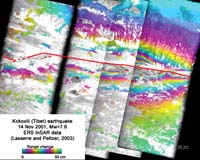
Stanford CA (SPX) Dec 12, 2006 In assessing the probability of an earthquake, scientists rely on two important pieces of data that are often inconsistent. The past geological record sometimes tells one story, while current measurements from the Global Positioning System (GPS) tell another. But a new forecasting model designed by Stanford University geophysicists may help close the gap. "This is the most realistic model to date," said Kaj Johnson, assistant professor of geological sciences at Indiana University, who worked on the modeling project several years ago when he was a Stanford graduate student. "This is something people had been asking for years now. It's the next step." Johnson and Stanford geophysics Professor Paul Segall will present their new probability model at 11:35 a.m. PT on Dec. 14, at the annual meeting of the American Geophysical Union in San Francisco during a talk titled "Distribution of Slip on San Francisco Bay Area Faults" in Room 307, Moscone Center South.
Measuring faults An important component of earthquake-probability assessment is determining how fast a fault moves. One technique involves the use of GPS, which allows seismologists to measure the movement of various points on the surface of the Earth, then use these data to extrapolate underground fault movement. Another way to determine fault slip rates is to dig a trench across the fault and find the signatures of past earthquakes, a method called paleoseismology. "People say, let's compare rates of fault movement from GPS to rates of fault movement from geologic studies," Segall said. "But it's as if you're measuring different parts of the same thing with different tools. The discrepancy can be quite big." To bridge the gap, Segall and Johnson created a new model that weaves together everything known about how a fault moves. The idea for the model came when Segall was asked to speak at a conference on the "rate debate," which is how geophysicists refer to the GPS-paleoseismology discrepancy. That's when he realized that the standard model doesn't take into account that fault-slippage rates vary over time. This time dependence is important, because GPS doesn't measure fault slippage directly. Rather, it measures how quickly points on the surface of the Earth are moving. Then scientists try to fit these data into mathematical models to estimate the rate of slip. "Because of the time-dependent rate, your estimate depends on where you are in the earthquake cycle," Segall said. "So if you use a model that doesn't take that into account, you will get a slip rate that's different." The scientists hope that their new updated model can give a more accurate picture of slip rates and reconcile the two pieces of fault data.
California and Asia With the new model, the team confirmed that the slip rates from GPS and from the geological record for the San Francisco Bay Area are relatively consistent. "Along the San Andreas system, the numbers tend to come out in reasonable agreement," Segall said. The next step for the scientists is to use their time-dependent model to scrutinize faults in other tectonically active regions, such as China, where there is a large disparity between contemporary GPS data and the paleoseismological record. "We want to take the same philosophy and procedure and apply it to different places in the world where the discrepancy can be quite big," Segall noted. "We're developing a strategy for how to move forward. We're still very much in the progress phase." Johnson is working on applying the new model to faults in Taiwan and Tibet, where the earthquake hazard is great. "This can help inform people who make the forecasts," Johnson said. "These new time-dependent models are going to become the norm, I think." Community Email This Article Comment On This Article Related Links Stanford University Stanford Report When the Earth Quakes Tectonic Science and News
 Hotspots Or Not - Isotopes Score One For Traditional Theory
 Providence RI (SPX) Dec 07, 2006
One great beauty of plate tectonics theory is that it explains so many geological phenomena at one time. But plate tectonics could not explain the location of many volcanic islands - Hawaii, the Azores or the Galapagos Islands, often called "hotspots" - far from the edge of tectonic plates. To deal with those observations, geologists invoked the concept of "plumes" - areas where buoyant sections of mantle material rose, melted and developed into concentrated upwellings of magma, forming seamounts and island chains. |
|
|

| The content herein, unless otherwise known to be public domain, are Copyright 1995-2006 - SpaceDaily.AFP and UPI Wire Stories are copyright Agence France-Presse and United Press International. ESA PortalReports are copyright European Space Agency. All NASA sourced material is public domain. Additionalcopyrights may apply in whole or part to other bona fide parties. Advertising does not imply endorsement,agreement or approval of any opinions, statements or information provided by SpaceDaily on any Web page published or hosted by SpaceDaily. Privacy Statement |