|
 |
 |
 |
 |
 |
 |
 |
 |

 |
New Mexico Voters Weigh Spaceport Tax Impost
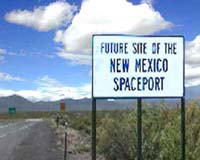
Los Angeles (AFP) March 26, 2007 New Mexico hopes to break ground soon on the world's first commercial spaceport, which state elders envision as a 21st-century departure point for thousands of paying space tourists. New Mexico's governor Bill Richardson worked with the southwest desert state's legislature to secure 33 million dollars for the final design of "Spaceport America," the world's first commercial spaceport. Now the voters in the Dona Ana County municipality where the project is to be located will weigh in, in a referendum scheduled for April 3 on a new sales tax to fund the project. If Spaceport America meets with voter approval, a maiden space voyage is expected in two to three years. If passed, the new tax would add 25 cents to a 100-dollar purchase, bringing in about 6.5 million dollars per year. The project cleared a first hurdle earlier this month, garnering broad support from local lawmakers. "The legislature gave its unanimous support to move forward aggressively with the spaceport," said Rick Homans, chairman of the New Mexico Spaceport Authority, in a statement. "They have given us the green light to put all systems 'Go,'" he said. New Mexico officials acknowledge being swept up in something of a space race in their bid to be the world's first functioning spaceport. "There are a handful of spaceports that have been announced globally. We view these spaceports as confirmation that a new industry is emerging," officials said in a statement. A 115-million-dollar spaceport is planned near Singapore's Changi International Airport in 2009, while developers in the United Arab Emirates are also building a 265 million dollar spaceport in Ras Al-Khaimah. In the United States, work on commercial spaceports is underway in California and Oklahoma, in addition to the New Mexico facility, which needs another 67 million dollars to get up and running and also would have to be licensed by the Federal Aviation Administration. The New Mexico Spaceport would be built on 18,000 acres of desert valley land rented from a handful of local ranchers for 25 years, with option to renew for successive 25-year terms. Homans said the state hopes to be able to keep to an "ambitious schedule" of getting off the ground by late 2009 or early 2010. Billionaire airline magnate Richard Branson's "Virgin Galactic" has signed on as the anchor tenant at Spaceport America. Late last year, the company selected New Mexico as its headquarters and already had invested 250 million dollars in the project. Only a handful of people around the world have been "space tourists." The most recent was an Iranian-born American woman who paid 25 million dollars to space tourism agency Space Adventures for a week-long ride into space. But critics of the New Mexico spaceport project worry about development, noise, and the potential drain on the region's already scarce supply of water. They also fear that the massive project will harm the region's natural beauty and could mar the majestic Camino Real desert trail -- an iconic attraction showcasing New Mexico's picturesque flatlands and dramatic mountain peaks. State officials, who say they believe the spaceport can coexist with New Mexico's natural wonders, wax poetic abut the project's potential. "When mankind is able to live work and play in space, on the moon, and on other planets, I believe it will have profound and positive impacts on humanity," they said in a statement. "It is hard to anticipate exactly what, how and how much, but clearly there will be impacts on research and development, manufacturing, energy development, and our understanding of the Earth, our atmosphere and how we fit into the larger universe."
Source: Agence France-Presse Community Email This Article Comment On This Article Related Links Spaceport America Launch Pad at Space-Travel.com Space Tourism, Space Transport and Space Exploration News
 Researchers Uncover Protection Mechanism Of Radiation-Resistant Bacterium
 Rockville MD (SPX) Mar 26, 2007
Recent discoveries by researchers at the Uniformed Services University of the Health Sciences (USU) could lead to new avenues of exploration for radioprotection in diverse settings. Michael J. Daly, Ph.D., an associate professor in USU's Department of Pathology, and his colleagues have uncovered evidence pointing to the mechanism through which the extremely resilient bacterium Deinococcus radiodurans protects itself from high doses of ionizing radiation (IR). |
|
|

| The content herein, unless otherwise known to be public domain, are Copyright 1995-2006 - SpaceDaily.AFP and UPI Wire Stories are copyright Agence France-Presse and United Press International. ESA PortalReports are copyright European Space Agency. All NASA sourced material is public domain. Additionalcopyrights may apply in whole or part to other bona fide parties. Advertising does not imply endorsement,agreement or approval of any opinions, statements or information provided by SpaceDaily on any Web page published or hosted by SpaceDaily. Privacy Statement |