|
 |
 |
 |
 |
 |
 |
 |
 |

 |
New Method Of Improving Computer Memory, Metal Seals, And Nanodevices
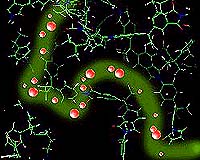
Albuquerque NM (SPX) Aug 09, 2004 A method that creates smooth and strong interfaces between metals and metal oxides without high-temperature brazing has been patented by researchers at the National Nuclear Security Administration's Sandia National Laboratories, Pacific Northwest National Laboratory, and the University of North Texas. The method can improve magnetic random-access memories, which allow next-generation computers to boot up instantly yet retain their entire memories after power interruptions. Depositing flat, nanometer-thin crystalline and ferromagnetic metallic layers on similarly thin oxide layers increases strength, stability, and uniformity of the oxide-metal interface. This reduces manufacturing cost and requires less electricity to produce more rapid magnetic effects for the computer memory. The inexpensive technique also may produce better, less expensive (more highly dispersed but stable) catalysts for chemical reactions, better ceramic/metal seals, and lead to improved nanodevices. The method works by controlling the growth and interfacial strength of a metal deposited on an oxide layer. There are two distinct methods within the patent. By fully hydroxylating the oxide surface and then cleansing it of impurities, a chemical reaction can oxidize a fraction of deposited metal atoms, incorporating them by strong ionic bonds into the oxide surface. However, these metal atoms also bind strongly to metallic atoms above them and serve as "anchors" to bind more metal. At sufficient concentration, laminar growth is achieved and crystallinity is observed by approximately six metal atomic layers. These findings are supported by both experimental and theoretical results. Another method controls the wetting characteristics (that is, the layer-by-layer deposition) and increases adhesion between a metal and an oxide layer. By introducing or producing a sub-monolayer of negatively charged species (e.g., a fraction of hydroxyl-radical coverage) to the surface of an oxide layer, layer-by-layer growth of metal deposited onto the oxide surface is promoted. This increases the adhesion strength of the metal-oxide interface. The negatively charged species can either be deposited directly onto the oxide surface or in the form of a compound that dissociates on, or reacts with, the surface to form the negatively charged species. The deposited metal adatoms are thereby bound laterally to the negatively charged species as well as vertically to the oxide surface, binding them strongly to the surface of the oxide, while otherwise they are bound weakly. This method has also been demonstrated by experiment and supported by theory. Community Email This Article Comment On This Article Related Links Sandia National Laboratories SpaceDaily Search SpaceDaily Subscribe To SpaceDaily Express Nano Technology News From SpaceMart.com Computer Chip Architecture, Technology and Manufacture
 Water, Water Everywhere Nano
 New York (UPI) Mar 18, 2005
One of the single biggest applications of nanotechnology could be solving the global shortage of pure water, experts told UPI's Nano World. |
|
|

| The content herein, unless otherwise known to be public domain, are Copyright 1995-2006 - SpaceDaily.AFP and UPI Wire Stories are copyright Agence France-Presse and United Press International. ESA PortalReports are copyright European Space Agency. All NASA sourced material is public domain. Additionalcopyrights may apply in whole or part to other bona fide parties. Advertising does not imply endorsement,agreement or approval of any opinions, statements or information provided by SpaceDaily on any Web page published or hosted by SpaceDaily. Privacy Statement |